 Odisha news today, Latest Oriya News Bhubaneswar Online Odia news Portal
By SOUMYARANJAN SAHOO
The public memory of Buddhism in Odisha often begins with Ashoka and pauses there. The rock edicts at Dhauli and Jaugada dominate both textbooks and heritage discourse, positioning Odisha as a moral theatre of Mauryan remorse after the Kalinga war. Yet, from an archaeological and anthropological perspective, Ashoka explains governance more than religion, inscriptional intent more than lived practice, and imperial ideology more than regional religious ecology.
When the edicts are decentered, a far wider and more complex Buddhist landscape comes into view—one shaped by rivers, trade, patronage networks, artisanal labour, and monastic mobility across centuries.
Ashokan Edicts as Administrative Speech, Not Religious Infrastructure
A lesser-discussed feature of the Dhauli and Jaugada edicts lies in what they do not mention. Neither site records the establishment of monasteries, the donation of land to sanghas, or the construction of stupas. Historians have repeatedly noted that Ashokan inscriptions served as proclamations of ethical governance rather than blueprints for religious expansion.
 |
Romila Thapar has emphasised that Ashoka’s dhamma was “a social ethic articulated through the state,” distinct from doctrinal Buddhism practised in monasteries. In Odisha, this distinction becomes archaeologically visible: monumental Buddhist architecture appears centuries after the Mauryan period, indicating that institutional Buddhism developed through regional mechanisms rather than imperial enforcement.
Another lesser-known aspect is spatial choice. Dhauli and Jaugada are located along communication routes and administrative frontiers, not within dense ritual landscapes. Their placement suggests audiences of officials, traders, and travellers rather than monks, reinforcing the idea that these sites belonged to political geography rather than monastic networks.
Invisible Early Buddhism: Perishable Spaces and Mobile Monks
The absence of pre-Ashokan or immediately post-Ashokan Buddhist monuments in Odisha has often been misread as the absence of Buddhism itself. Archaeologists increasingly caution against this assumption. Early Buddhist practice relied heavily on perishable materials—wooden structures, earthen platforms, temporary shelters—that leave little trace after two millennia. Anthropologist Gregory Schopen’s work on monastic archaeology elsewhere in India has demonstrated that inscription-heavy, stone-built monasteries represent later institutional phases rather than beginnings.
In Odisha, early Buddhism likely circulated through itinerant monks moving along trade routes, staying in seasonal shelters near settlements and river crossings. Such mobility aligns with early Buddhist emphasis on mendicancy and oral transmission. The archaeological silence of this phase reflects material fragility, not cultural absence.
Rivers as Monastic Highways: The Internal Geography of Buddhism
 |
One of the most underappreciated facts about Buddhist Odisha is the alignment of sites along river systems rather than political capitals. The Brahmani, Baitarani, Mahanadi, and their tributaries structured settlement density, agricultural surplus, and seasonal mobility. Sites such as Kayama, Deuli, and Langudi sit close to these river corridors, suggesting that monks followed the same pathways as traders, pilgrims, and artisans.
Archaeological surveys reveal that many Buddhist sites are positioned near ancient river ports or crossing points rather than urban centres. This pattern supports Himanshu Prabha Ray’s argument that Buddhist institutions thrived within “ritual economies of circulation,” in which rivers served as conduits for both material wealth and religious ideas. Odisha’s rivers effectively stitched together inland monastic spaces with coastal exchange networks.
Langudi: A Buddhist Landscape Without a Monastery
Among Odisha’s lesser-known sites, Langudi presents one of the most intriguing anomalies. Spread across multiple hillocks, Langudi contains rock-cut stupas, standing Buddha images, and carved panels, yet lacks a clearly defined monastic complex of the Nalanda or Ratnagiri type. Archaeologists interpret this as evidence of an open-air ritual landscape rather than a residential monastery.
Langudi’s spatial dispersal suggests pilgrimage-based worship, possibly serving itinerant monks and lay devotees rather than a permanent sangha. Some scholars propose that Langudi functioned as a liminal ritual zone, complementing the more institutionalised centres of the Diamond Triangle. This challenges the assumption that Buddhism always expressed itself through enclosed monastic architecture.
 |
Kayama and Deuli: Peripheral Sites with Core Functions
Sites such as Kayama and Deuli rarely appear in mainstream narratives, yet their material remains offer critical clues about Buddhist diffusion. Kayama’s fragmentary stupas and sculptures indicate small-scale ritual activity tied to local patronage. Deuli, located closer to the Mahanadi basin, reveals sculptural styles that bridge Odisha and Bengal, suggesting artisanal mobility across regions.
These sites are best understood as functional satellites—places of worship, teaching, or retreat that operated in dialogue with larger monastic hubs. Anthropologist Dilip K. Chakrabarti has described such locations as “support nodes,” essential for sustaining expansive religious systems despite their modest scale.
Artisans, Workshops, and the Economics of Devotion
A rarely discussed aspect of Buddhist Odisha involves production rather than philosophy. Votive stupas, stone images, and terracotta plaques are found in large numbers across sites, suggesting workshop activity and skilled labour. At several locations, including Langudi and Kayama, unfinished sculptures and partially carved stone blocks have been reported, suggesting on-site or nearby production.
This evidence reframes Buddhist sites as centres of artisanal employment and economic activity. Donations not only support monks but also sustain sculptors, stone-cutters, metalworkers, and transporters. Buddhism in Odisha thus operated as a cultural economy embedded within local livelihoods, not merely as a spiritual movement.
The Maritime Dimension: Odisha and the Bay of Bengal World
 |
Odisha’s coastline connected it to a vast maritime network linking eastern India with Sri Lanka and Southeast Asia. While Odisha lacks a surviving Buddhist port monastery comparable to those in Bengal, stylistic parallels in sculpture and iconography point to sustained contact. Certain Avalokitesvara and Tara images from Odisha display affinities with Southeast Asian forms, particularly in ornamentation and posture.
Himanshu Prabha Ray has noted that monasteries near coastal corridors often served as reception points for monks arriving by sea. In this reading, Odisha’s inland Buddhist centres functioned as hinterland anchors for maritime Buddhism, absorbing and retransmitting ideas circulating across the Bay of Bengal.
Overlapping Religious Worlds: Buddhism Amid Shaiva and Vaishnava Growth
Another underexplored fact concerns coexistence. Archaeological layers in Odisha frequently reveal Buddhist, Shaiva, and later Vaishnava material within overlapping chronological frames. Rather than religious displacement, this pattern suggests shared patronage networks and fluid devotional identities. Land grants, artisanal labour, and ritual spaces often served multiple traditions over time.
Historian B.D. Chattopadhyaya’s insight that early medieval India experienced “reconfiguration of religious investment rather than doctrinal replacement” finds strong support in Odisha’s evidence. Buddhist institutions adapted, specialised, and sometimes contracted without vanishing abruptly, leaving behind residual landscapes that continued to inform regional memory.
Repositioning the Diamond Triangle Within This Larger Map
 |
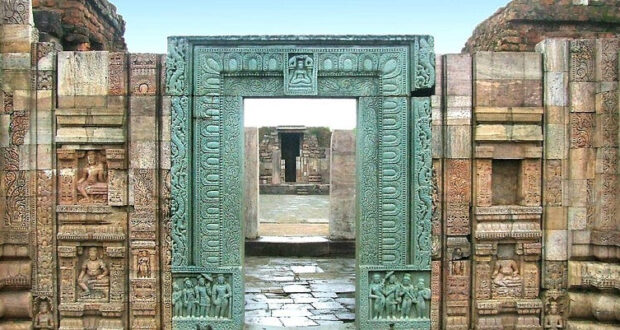
When placed within this broader geography, the Diamond Triangle appears as the most concentrated expression of processes unfolding across Odisha for centuries. Its scale reflects intensification rather than exception. The Triangle consolidated monastic residence, advanced ritual practice, and artisanal production within a compact zone, drawing upon networks already active throughout the state.
UNESCO’s serial framing gains deeper meaning against this backdrop. Lalitgiri, Ratnagiri, and Udayagiri emerge not as isolated monuments but as the institutional apex of a dispersed Buddhist world extending across rivers, hills, and coastal routes.
Odisha as a Buddhist Region, Not a Footnote
Buddhist Odisha unfolds through fragments, corridors, and residual spaces rather than singular monuments. Beyond Ashoka’s inscriptions lies a layered religious geography shaped by movement, labour, and adaptation. The Diamond Triangle represents the most visible node within this system, yet its significance becomes clearer only when read alongside lesser-known sites, artisanal evidence, and riverine networks. Understanding Buddhist Odisha in this way shifts the narrative from imperial moment to regional continuity, from isolated sites to an interconnected cultural landscape.
References
- Thapar, Romila. Ashoka and the Decline of the Mauryas. Oxford University Press.
- Ray, Himanshu Prabha. The Archaeology of Seafaring in Ancient South Asia. Cambridge University Press.
- Chakrabarti, Dilip K. The Archaeology of Eastern India. Oxford University Press.
- Schopen, Gregory. Bones, Stones, and Buddhist Monks. University of Hawai‘i Press.
- Archaeological Survey of India. Dhauli and Jaugada Rock Edicts. ASI Publications.
- Huntington, Susan L. The Art of Ancient India. Weatherhill.
- UNESCO World Heritage Centre. Buddhist Sites of Odisha: Diamond Triangle, Tentative List Dossier.