

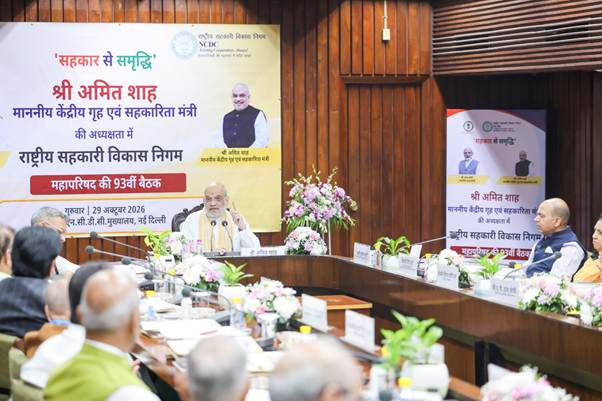
New Delhi:29/10/26:In furtherance of Prime Minister Shri Narendra Modi's vision of ‘Sahkar se Samriddhi’ and towards accelerating cooperative-led development that reaches every citizen and includes every section of society, the 93rd Meeting of the General Council of the National Cooperative Development Corporation (NCDC) was held today at the Corporation's headquarters in New Delhi under the chairmanship of Union Home Minister and Minister of Cooperation Shri Amit Shah. The meeting deliberated on various matters relating to NCDC's financial and institutional achievements, expansion of financing in the cooperative sector, development of new Multi-State Cooperative Societies, strengthening of rural livelihoods and the Corporation's future roadmap.
Addressing the General Council meeting, Union Home Minister and Minister of Cooperation Shri Amit Shah said that NCDC has delivered highly commendable performance over the past nearly five years. The Corporation has not only made significant progress in its financial performance and achievement of prescribed targets but has also recorded important accomplishments, including increased profit per employee, expansion in loan sanctions and disbursements, and maintenance of zero net Non-Performing Assets (NPAs). He expressed particular satisfaction that NCDC has now established its presence in all States and Union Territories of the country. The expansion of offices into remote regions such as Ladakh and smaller States of the North-East marks an important step towards taking the cooperative movement to the remotest parts of the country. Shri Amit Shah congratulated the officers and employees of the Corporation on these achievements.
Shri Amit Shah said that Prime Minister Shri Narendra Modi fulfilled a decades-old demand of the cooperative sector by establishing a separate Ministry of Cooperation. The objective is not merely to increase the number of cooperative institutions but to connect every citizen of the country with the development process. He observed that the development of a vast country like India cannot be assessed solely based on Gross Domestic Product, per capita income or industrial investment. True development also means ensuring that every section of society has access to opportunities, every citizen can lead a life of dignity, and everyone is able to contribute to the nation's progress. He explained that development reaching every citizen signifies Sarvasparshi Vikas, while Sarvasamaveshi Vikas means ensuring equal participation of all regions, from Ladakh to Lakshadweep, in the country's development journey.
The Union Home Minister and Minister of Cooperation said that cooperation is the most effective means of connecting the collective strength of small farmers, livestock rearers, rural women, fishermen and economically weaker sections, who have limited capital, with national development. Cooperative institutions can bring together large numbers of people with limited capital and create new opportunities in production, processing, marketing and income generation. He said that Amul, IFFCO and several other successful cooperative institutions in the country demonstrate that globally competitive organisations can be developed by combining cooperative values with professional management. Referring to the outstanding performance of Indian cooperative institutions in international cooperative rankings, he described it as a matter of pride for the entire cooperative sector of the country.
Shri Amit Shah said that NCDC has expanded its activities across production, processing, marketing, rural industrial activities, water conservation, agricultural insurance, cooperative banking and sectors associated with the circular economy. The Corporation has also played a significant role in the formation, capital investment and operations of national-level Multi-State Cooperative Societies. He observed that, considering NCDC's achievements over the past five years, this period could be described as a golden era of sorts for the Corporation. However, he emphasised that these achievements should not lead to complacency. Comprehensive reforms are needed in the Corporation's institutional structure, capacity to mobilise financial resources, professional functioning and models of partnership with cooperative institutions to meet changing requirements.
The Union Home Minister and Minister of Cooperation directed NCDC to prepare a comprehensive roadmap for the next 25 years. He said that a group comprising experienced representatives of the cooperative sector and professional experts should be constituted to examine the Corporation's existing structure, alternative avenues for capital mobilisation, participation of cooperative institutions, financial autonomy, organisational reforms and future business opportunities. He also suggested organising a workshop on these issues. Shri Amit Shah said that a special meeting should be convened for detailed presentations and deliberations on the subject so that progress could be made towards taking the necessary decisions.
Shri Amit Shah said that the administrative systems of cooperative institutions should be professional, while their fundamental approach must remain rooted in cooperative principles. He observed that excessive dependence on government assistance and government banks creates certain limitations for institutional development. NCDC should, therefore, develop financial and organisational models that enable the Corporation to mobilise resources in line with its growing requirements and fully harness the potential of the cooperative sector. He said that while the development of the cooperative sector is NCDC's responsibility, ensuring NCDC's own development should be the collective resolve of all members of the General Council.
The Union Home Minister and Minister of Cooperation appreciated NCDC's role in the development of institutions such as National Cooperative Exports Limited (NCEL), Bharatiya Beej Sahakari Samiti Limited (BBSSL), National Cooperative Organics Limited (NCOL), Bharat Taxi, Sahakar Sarathi and the National Urban Cooperative Finance and Development Corporation (NUCFDC), the umbrella organisation for Urban Cooperative Banks. He expressed confidence that these institutions could emerge as large and influential Multi-State Cooperative Societies at the national level in the coming years. He said that, alongside providing financial assistance to large cooperative enterprises, bringing about direct improvements in the livelihoods of small farmers, livestock rearers and fishermen is an equally important responsibility of NCDC.