

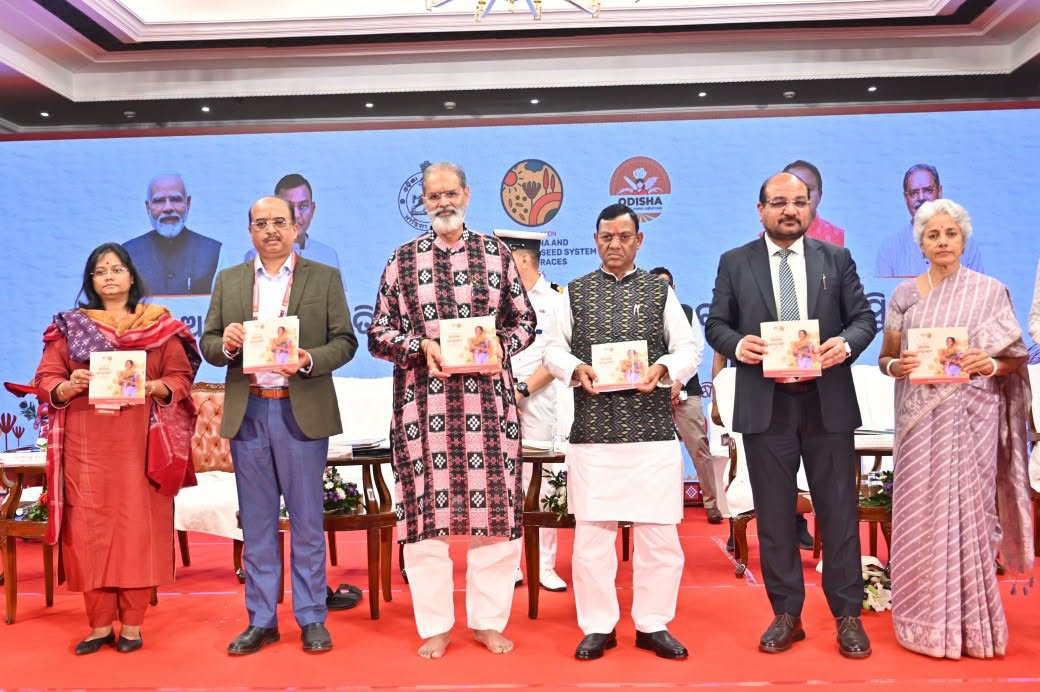
Bhubaneswar:10/11/26:Odisha has laid down a
comprehensive national roadmap for millet-led agricultural transformation.
The
ambitious blueprint was presented during the inaugural day of a two-day
national event on Agro-Biodiversity Conservation, Climate-Resilient
Agriculture, and Sustainable Food Systems, which commenced today in
Bhubaneswar.
The high-level gathering brought together key dignitaries, including Brajmohan Ram, Governor of Odisha; Kanak Vardhan Singh Deo, Minister for Agriculture and Farmers’ Welfare, Government of Odisha; Dr. Mangi Lal Jat, Secretary (DARE) and Director General (ICAR); Dr. Soumya Swaminathan, Chairperson of the M.S. Swaminathan Research Foundation; and Sachin Ramachandra Jadhav, IAS, Commissioner-cum-Secretary, Department of Agriculture and Farmers’ Empowerment, Government of Odisha.
 Ambitious Targets for 2047
Delivering the keynote address, Dr.
M.L. Jat highlighted the critical role of Odisha’s rich agro-biodiversity in
tackling modern agricultural challenges, including climate change, soil
degradation, and nutritional insecurity. He praised the success of the Odisha Shree Anna Abhiyan, describing it as a
scalable model for the entire nation.
Dr. Jat outlined a vision to expand millet cultivation in Odisha from the current 1.79 lakh hectares to 5 lakh hectares by 2047, targeting a production volume of 8 lakh metric tonnes. He commended the state’s progress in finger millet (ragi) procurement, noting the receipt of 7.5 lakh quintals in Kharif Marketing Season (KMS) 2024-25 and a targeted 8 lakh quintals for KMS 2025-26.

Preserving Indigenous Diversity & Minor
Millets
A core focus of the event was the
preservation of traditional landraces. Dr. Jat emphasized the importance of
safeguarding the 163 documented finger millet landraces native
to Odisha, particularly popular indigenous varieties such as Kalia, Bati, Mami, and Bharathi.
Beyond finger millet, the roadmap
calls for scaling up scientific cultivation practices for minor millets like suan (little millet) and kangu (foxtail millet).
Strengthening
Infrastructure and Research
To support farmers and boost local food
economies, the roadmap highlights several strategic interventions:
Processing & Technology: Development of affordable, localized processing machinery.
Empowerment: Strengthening Farmer Producer Organizations (FPOs) and
Women Self-Help Groups (SHGs) to expand market access.
Research Collaboration: Deepening
institutional ties between ICAR-Indian Institute of Millets Research (IIMR),
Hyderabad, and local bodies.
Centre of Excellence: A
proposal to establish a dedicated Centre of Excellence on Millets at
the Odisha University of Agriculture and Technology (OUAT).
The two-day conference features interactive
exhibition stalls showcasing agricultural innovations, indigenous seed
diversity, and millet-based products, fostering direct dialogue between
scientists, policymakers, and local farmers.