

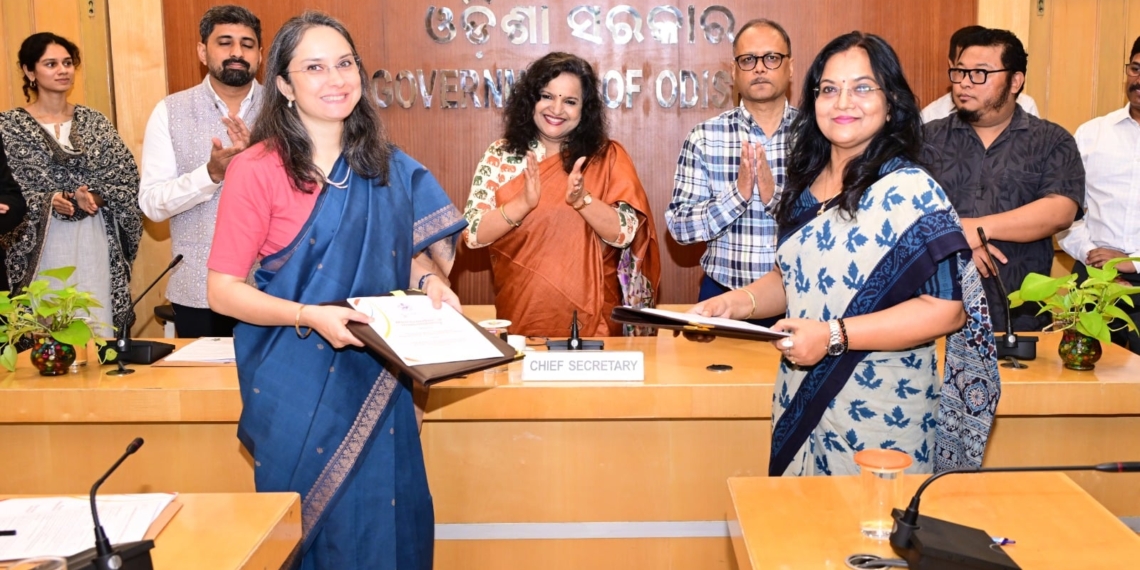
Bhubaneswar:4/11/26:The
Government of Odisha has signed a three-year Memorandum of Understanding (MoU)
with the Abdul Latif Jameel Poverty Action Lab (J-PAL) South Asia to anchor
evidence-based policymaking across state departments.
The strategic
partnership, anchored in the Planning & Convergence Department, directly
aligns with the state’s ambitious targets under Odisha Vision 2036 (Samruddha Odisha) and Odisha Vision 2047 (Viksit Odisha).
The MoU was formally
signed by Rashmi Kabi, FA-cum-Additional Secretary, Planning & Convergence
Department, and Shobhini Mukerji, Executive Director of J-PAL South Asia. The
signing ceremony took place in the presence of Chief Secretary Anu Garg,
Development Commissioner-cum-Additional Chief Secretary Deoranjan Kumar Singh,
Acting Associate Director (Policy) at J-PAL South Asia, Murali Mallikarjunan,
alongside Secretaries from key state government departments.
Scaling Proven
Solutions & Global Best Practices
Under the
new agreement, J-PAL South Asia—hosted at the Institute for Financial
Management and Research (IFMR) in Chennai—will work closely with various state
departments to identify priority challenges, conduct rigorous evaluations, and
translate research into actionable recommendations.
The partnership
builds upon a long-standing association dating back to 2006. Over the years,
J-PAL South Asia has collaborated with Odisha on critical initiatives across
early childhood education, foundational literacy, governance, sanitation,
agriculture, and gender equity. A key example is Barnali, a gender-equity curriculum currently taught in
roughly 23,000 government schools, where J-PAL South Asia serves as the
knowledge and research partner alongside the School & Mass Education
Department and Breakthrough Trust.
Outlining
the vision for the collaboration, Anu Garg, Chief Secretary, Government of
Odisha, highlighted the state’s commitment to modern governance:
“We have set ourselves an ambitious goal of Viksit Odisha for Viksit
Bharat. Our Vision commits us to engaging research institutions in policy
research and piloting innovations, as well as adopting data- and AI-based
interventions in line with global best practices. I see J-PAL South Asia’s role
as threefold: first, to bring the most relevant global evidence to bear on our
priorities; second, to work with our departments to adapt promising approaches
to Odisha’s needs; and third, to support us in designing and testing evidence-
and data-based solutions before they are taken to scale.”
Governance
and Implementation Structure
To ensure
seamless execution across government bodies:
A Steering Committee chaired
by the Chief Secretary, comprising senior officials and J-PAL leadership, will
meet every six months to review proposed projects.
Designated nodal officers from both the
government and J-PAL South Asia will handle day-to-day coordination.
Department-specific
deliverables and research scopes will be co-designed based on each department’s
strategic needs.
Founded
by Nobel Laureates Abhijit Banerjee and Esther Duflo alongside Sendhil
Mullainathan, J-PAL leads a global network of over 1,000 affiliated researchers
dedicated to tackling poverty through randomised evaluations. This refreshed
partnership puts rigorous science at the heart of Odisha’s roadmap toward
economic prosperity and social progress over the next two decades.