

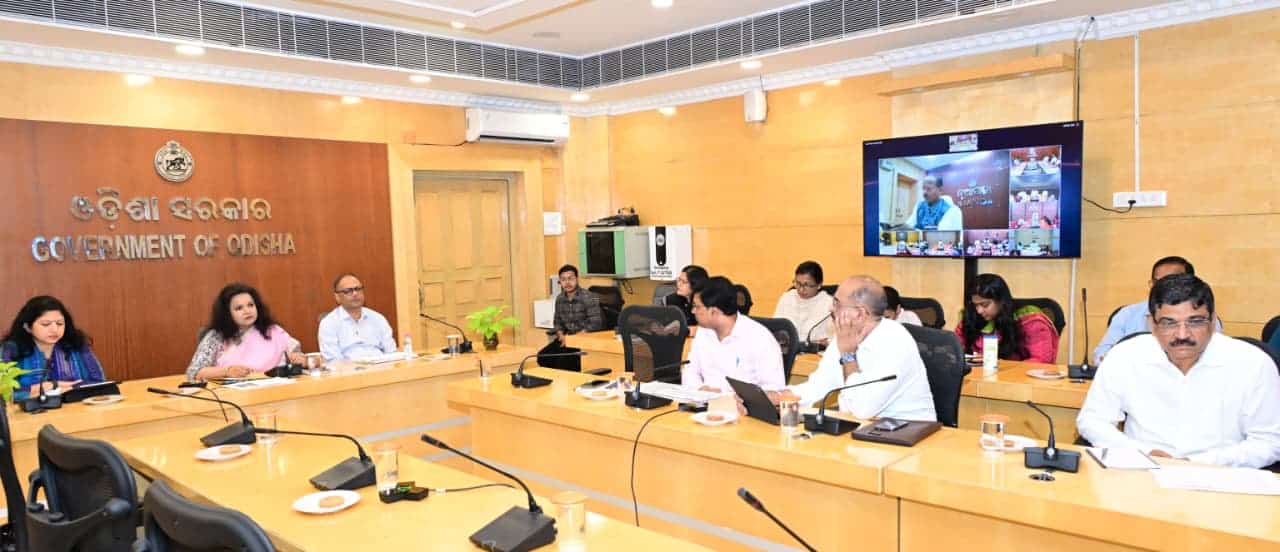
Bhubaneswar:17/9/26:Odisha’s top bureaucracy put district delivery under the scanner on Thursday as Chief Secretary Anu Garg chaired a high-level review with Collectors at Lok Seva Bhawan, pressing them to resolve land, approval and implementation delays so that approved projects actually reach people.
Development Commissioner-cum-ACS Deoranjan Kumar Singh, ACS, Housing and Urban Development, Usha Padhee, and secretaries and senior officers of several departments were present. All Collectors joined the discussion virtually.
The meeting covered progress of major departmental schemes at the district level — land-related hurdles, pending sanctions, execution gaps and the district-level action required to close them. Housing and Urban Development, Labour and ESI, Women and Child Development, Health and Family Welfare, Handlooms, Textiles and Handicrafts, Odia Language, Literature and Culture, School and Mass Education, Agriculture and Farmers’ Empowerment, and MSME all figured on the agenda.
Water, waste and city finances
Urban drinking water projects and land problems holding up water supply and other civic works were among the first items taken up. Collectors of Khordha, Sambalpur and Cuttack were asked to move immediately on land issues affecting five priority projects.
Officials also reviewed market-based fundraising for smaller urban local bodies under the Credit Repayment Guarantee Sub-Scheme and district-level compliance with waste-management rules in line with Supreme Court directions.
Health, labour and nutrition
On the labour and ESI side, the review covered land arrangement for a 100-bed ESI hospital, district task-force meetings on child-labour eradication, labour inspection committees, and regular meetings and mock drills of district and local crisis-management groups for chemical accidents.
The Women and Child Development Department’s agenda included Poshan Maah-2026, the Suposhit Odisha Mission and digital monitoring forms. Stress was laid on identifying and referring malnourished children during Nutrition Month, registering pregnant women, involving fathers, and expanding nutrition services in hard-to-reach areas.
Health and Family Welfare discussions focused on biomedical waste management, land for primary health centres, the AYUSH Medical College, work under the ‘Ama Hospital’ initiative, and district-wise progress of the National Tuberculosis Elimination Programme.
Heritage villages, crafts and classrooms
The Handlooms, Textiles and Handicrafts Department reviewed the Srijnika craft cluster and other major clusters across handicrafts, handloom, silk and weaving.
From the Odia Language, Literature and Culture Department came a progress check on the Baraputra Aitihya Gram Yojana, the scheme to develop birthplaces of eminent Odias as heritage sites. Officials discussed district-wise land allotment, project DPRs, and steps to remove execution barriers.
School and Mass Education reviewed the Godabarish Mishra Adarsh Primary School scheme, residential hostels of Odisha Adarsha Vidyalayas, creation of APAAR IDs for students, and related issues.
Farms and small industry
Agriculture and Farmers’ Empowerment reported on farmer registration under AgriStack and the progress of the Kharif-2026 digital crop survey.
The MSME Department was asked about regular meetings of district-level Single Window Clearance Authorities, MSME parks, the Odisha startup ecosystem and credit facilitation. A detailed discussion followed on the plan to develop 30 MSME parks in 30 districts.
The Chief Secretary’s bottom line
Garg told Collectors to work in close coordination with line departments and settle land acquisition, project approvals, construction and implementation problems within fixed timelines, while reviewing progress regularly. District-level monitoring and inter-departmental coordination, she said, must ensure that the benefits of sanctioned projects and schemes reach people without delay.
The review reflected the state administration’s monthly Collector-level drill: not a ceremonial stock-take, but a push to convert files into water connections, hospital beds, classrooms, heritage sites and industrial parks.