

Bhubaneswar:5/11/26:Following widespread destruction caused by Cyclone Arnab and subsequent flooding, an 8-member Central Inter-Ministerial Team visited Odisha to assess the ground-level damage.
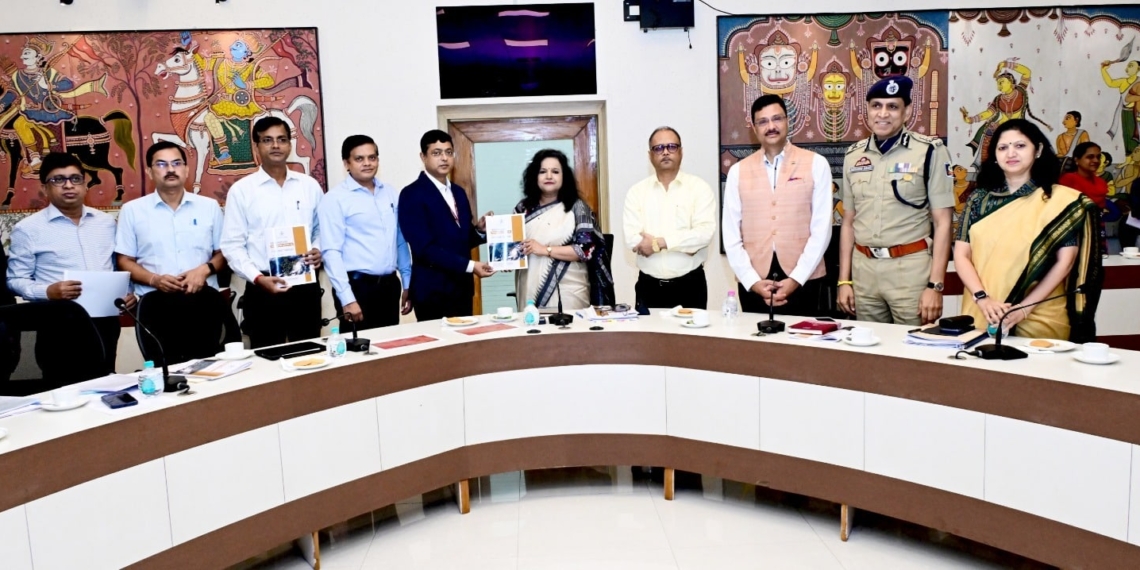
Today, the team participated in a high-level preliminary review meeting at the Lok Seva Bhawan conference hall, hosted by the Special Relief Commissioner (SRC).
The meeting was chaired by Odisha Chief Secretary Mrs Anu Garg and led by Joint Secretary of the Union Ministry of Home Affairs, Mr Ravi Shankar. The central delegation included representatives from the Ministry of Agriculture and Farmers Welfare, the Directorate of Rice Development (Patna), the Department of Expenditure (Ministry of Finance), the Central Water Commission, the Central Electricity Authority, the Ministry of Road Transport and Highways, the Ministry of Rural Development, and the National Remote Sensing Centre (NRSC, ISRO).
State-level officials in attendance included Development Commissioner and Additional Chief Secretary Mr Deo Ranjan Kumar Singh, Additional Chief Secretary of the Revenue Department Dr Arvind Kumar Padhee, Special Relief Commissioner Mr Rajesh Prabhakar Patil, alongside senior secretaries and representatives from various state departments, including Revenue, Urban Development, Water Resources, Works, Agriculture, Health, Rural Development, Panchayati Raj, and Energy.
Led by Mr Ravi Shankar, the central team inspected severely affected areas in Gajapati district on November 3 and Ganjam district on November 4. During the meeting, the team presented their field observations, noting extensive damage to crops, roads, power supply infrastructure, river embankments, canals, fish ponds, and livestock.
District collectors reported that due to the massive scale of destruction, a complete and exhaustive damage assessment will take a few more days. The central team recommended conducting a thorough, house-to-house survey to ensure every impacted family is accounted for. They also assured the state of central assistance for ongoing relief, reconstruction, and the strengthening of vital river embankments.
Discussions during the meeting focused on long-term infrastructure resilience, including increasing the height and reinforcement of vulnerable river embankments and canals. While temporary repairs have restored connectivity across various national highways, rural roads, and bridges overseen by the Works, Rural Development, and Panchayati Raj departments, authorities emphasised the necessity of permanent, climate-resilient solutions.
Chief Secretary Mrs Anu Garg briefed the central delegation on Odisha’s rich history of managing severe natural calamities, dating back to the devastating 1999 Super Cyclone. She highlighted that because Odisha faces multiple natural disasters annually, the state government prioritises proactive preparedness, rapid deployment, and swift rescue and relief operations.
Mrs Garg reiterated that continuous efforts are being made to develop disaster-resilient infrastructure and institutional capacity across the state to minimise future risks and safeguard public life and property.