 Odisha news today, Latest Oriya News Bhubaneswar Online Odia news Portal
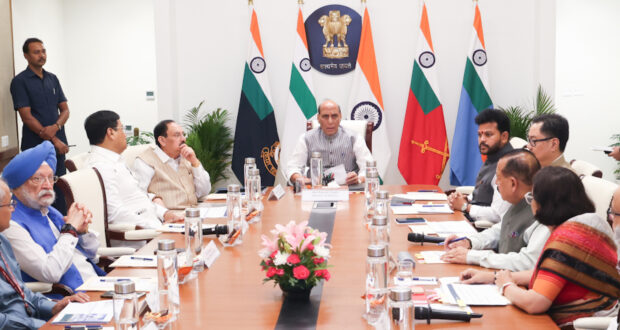
Newdelhi:11/5/26:Raksha Mantri Shri Rajnath Singh chaired the 5th meeting of the Informal Group of Ministers (IGoM) on West Asia at Kartavya Bhawan-2, New Delhi on May 11, 2026. The meeting took stock of the latest developments in the conflict, and discussed ways to bolster India’s readiness to ensure its minimum effect on the people. Minister of Chemicals & Fertilizers Shri Jagat Prakash Nadda; Minister of Petroleum and Natural Gas Shri Hardeep Singh Puri; Minister of Railways, Information and Broadcasting, Electronics & Information Technology Shri Ashwini Vaishnaw; Minister of Parliamentary Affairs Shri Kiren Rijiju; Minister of Civil Aviation Shri Kinjarapu Rammohan Naidu, Minister of Ports, Shipping and Waterways Shri Sarbananda Sonowal; and Minister of State (Independent Charge) of the Ministry of Science & Technology Dr Jitendra Singh attended the meeting.
The IGoM was informed that the country is secure, and there is no shortage of any petroleum product, even as most other nations have taken emergency measures to dramatically reduce domestic consumption. India has 60 days of crude oil, 60 days of Natural Gas and 45 days of LPG rolling stock. The foreign exchange reserves stand at a comfortable $703 billion. India is the world’s third largest oil refiner and fourth largest exporter of petroleum products, exporting to over 150 countries and is meeting domestic demand in full. But there is a huge cost being borne by the nation as international crude prices are continuing at very high levels. Fuel conservation can ease this burden. Prime Minister Shri Narendra Modi’s appeal to the people for collective participation to help the country deal with global economic disruptions, supply chain challenges and rising prices caused by international conflicts has, thus, emphasised prudence in the usage of petroleum products and reducing wasteful consumption, so that the fiscal burden on the nation is reduced in the present and into the future.
The IGoM was informed that fertiliser availability remains robust, with supplies continuing to exceed requirements. Overall stock position of fertilizers in the country is as follows (Lakh Tons):
| Product | Stock As
on 11.05.2026 |
Stock As
on 11.05.2025 |
| Urea | 76.65 | 75.48 |
| DAP | 22.52 | 14.87 |
| NPKs | 60.42 | 48.32 |
| SSP | 26.99 | 26.92 |
| MOP | 13.07 | 12.99 |
| Total | 199.65 | 178.58 |
For Kharif 2026, the fertiliser requirement has been assessed by DA&FW at 390.54 LMT, against this stock as on today is around 199.65 LMT (more than 51%), significantly higher than the usual level of about 33%. This reflects improved planning, advanced stocking, and efficient logistics management by the Government.
Domestic production and import of fertilizers after crisis (Lakh Tons):
| Product | Domestic production after crisis (01.03.2026 to 10.05.26) | Domestic production (01.03.2025 to 10.05.25) |
| Urea | 46.28 | 54.98 |
| DAP | 6.20 | 5.56 |
| NPKs | 15.57 | 22.03 |
| SSP | 8.73 | 9.44 |
| Total | 76.78 | 92.01 |
Sale of Fertilizers (Lakh Tons):
| Product | Sale 01.03.26 to 10.05.26 | Sale 01.03.25 to
10.05.25 |
| Urea | 38.94 | 34.60 |
| DAP | 9.40 | 6.17 |
| NPKs | 14.25 | 11.71 |
| SSP | 5.52 | 4.28 |
| MOP | 3.08 | 2.89 |
| Total | 71.19 | 59.65 |