
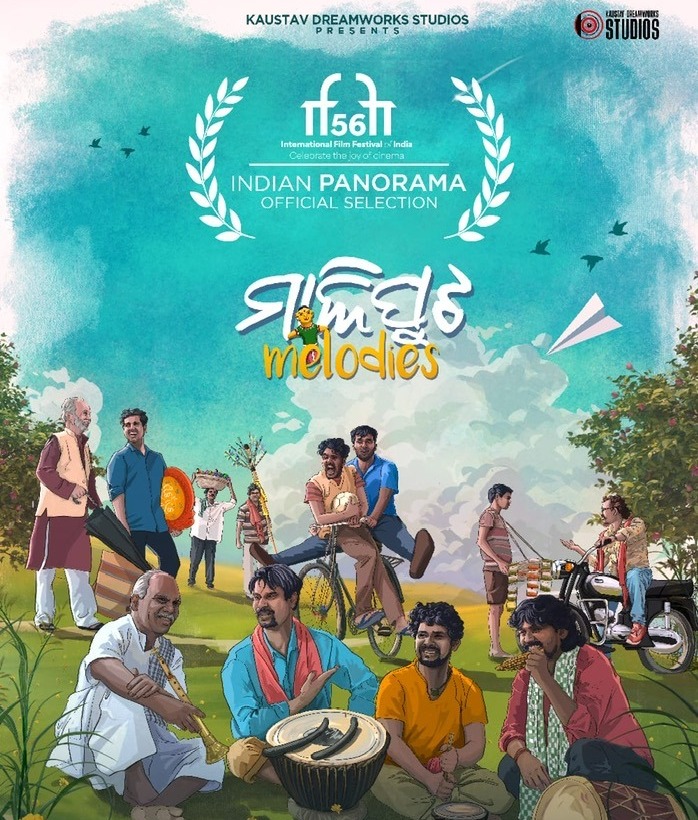
Bhubaneswar:8/11/25: by Ashok Palit: International Film Festival of India, better known as IFFI, is among the oldest film festivals in the Asian continent. Beginning in 1952, the festival has acted as a platform forthe popularisation of Indian cinema to a global audience while acting as an introduction of sorts for foreign films to Indian cinephiles spread over selected cities. In 1978, for the first time, the regional cinema entered the festival. Since its inception, only twenty Odia films have been selected in In Panorama section. This year, at the 56th edition of the festival being held from November 20 to 28,2025, at Goa, Odia film Maliput Melody is an official entry in the Indian Panorama Section.
‘Maliput Melodies‘ is a heartwarming Odia feature film that captures the essence of rural life in Odisha through a collection of poignant stories. Each tale highlights the beauty of simple living and the significance of small joys, while also revealing the vulnerabilities of these lives to external changes.
The first story, “KANAPHULA,” follows two friends who sell toys and flutes, eagerly preparing for the Rathyatra festival to earn money for golden earrings for their daughters. Their dreams are dashed when the festival is canceled due to rising COVID cases, forcing them to confront their shattered hopes.
In “RANGAMATI,” two brothers embody contrasting views on life. The practical younger brother, Sana, supports their family, while the elder brother, Bada, dreams of a better life in Bangalore. A conversation with a villager who has returned from the city challenges Bada’s aspirations and makes him reconsider his choices.
“BAIDAKARIA” tells the story of a traditional band eagerly awaiting a call to perform at the Dussehra Puja. As the days pass without news, tension rises among the band members, leading them to investigate the situation, only to uncover unexpected truths.
Finally, “BHIBHAGHAR” portrays the intricate preparations of a middle-class family for a wedding, showcasing their resilience as they navigate various challenges leading up to the big
day. Together, these stories weave a rich tapestry of life in rural India, celebrating the dreams, struggles, and enduring spirit of its people. This film is being produced by Kausik Das under the banner of AAONXT & directed by Vishal Pattnaik.
Director Vishal Patnaik is an Art teacher at a high school in Odisha. After graduating from Chennai College of Fine Arts, Chennai, with a Bachelor’s in Painting, he started making short films with the help of his friends and family.
Belonging to a small town, Jeypore, where there was no culture of cinema/filmmaking, he learnt from books, the internet, and watching movies. The finances required for the short films were supported by his elder brother and his father. With minimal crew and equipment, he and his friends together made films that represented stories and the lives of people in the rural areas of Koraput district, Odisha. Using local talents and training them to act in the films was a challenge.
Here are some of the Odia entries that have, over the years, found a pride of place in the Indian panorama.
Seeta Rati was the first Odia film to be selected for the Panorama in 1983, directed by Manmohan Mahapatra. This debut venture of Mahapatra was the first new wave Odia movie. After that 1985, 1,986, and 1988, Mannmohan Mahapatra’s three movies Nirab Jhada, Klanta Aparanha, and Majhi Pahacha were selected for screening in Panoramandian panorama. In 1984, Maya Miriga, directed by Nirad Mahapatra, and Dhare Allu, directed by Sagir Ahamed, were also selected.
While Nirad Mahapatra’s Maya Miriga (The Mirage) revolved around the clash between the past, present, and future, parents and children, men and women, the traditional and the modern, Dhare Alua (A Ray of Light) was based on a story by Manorama Das.
In 1995 a, nd 1996, Aranya Rodan and Nirbachan, both directed by Late Biplab Ray Coudadhry, were selected for Indian Panorama. Aranya Rodana concentrated on the story of a hardworking lady journalist surviving in a tribal dominated place, based on the novel Ashanta Aranya by Odia writer Satakadi, Hota, and Nirbachana, presented a stunningly controlled and uniquely cinematic metaphor of rural India.
In 1992, 1997, and 1998, Adi Mimansha, Lavanyya Preeti, and Sesha Drusti, Mumbai-basedcameraman-cum-director Apoorva Kishore Bir were selected for the festival. While NFDC produced Adi Mimansha threw light on the issues of poverty and surmiddle-classiddle class family, Sesha Drusti effectively portrayed two generations trapped in a web -one that can’t break away from its past, the other that tries to deal with a present with no future. LavanyaPreeti deals with the subtle and delicate exposition of the growing-up process from childhood to adolescence through the use of myths and striking visuals.
In 1999, Bijoy Ketan Mishra’s Ahalya was selected for the Indian Panorama. Mishra’s maiden directional effort, Ahalya (The Words of Silence), depicted the mute suffering of a hapless woman, widowed in her childhood.
In 2000, Biswaprakash, directed by Susant Mishra, was selected. Biswaprakash, a young man in his early 20s, was a rebel constantly revolting against the obscure traditional lifestyle of his family, rooted deeply in the medieval socio-religious mores.
In the world of Odia parallel cinema, another successful filmmaker is Prafulla Mohanty, who has given a cinematic shape and texture to Godabarish Mohapatra’s widely read story Maguni Ra Sagada. With the flow of time and progress in civilization, how Sagada (bullock cart), the most important transport of yesteryears in the villages, became a useless product. This was echoed in the film, which was selected for the Indian Panorama for the year 2002.
In 2010, Swayamsiddha, directed by Sudhanshu Sahu, also got an entry into the Indian Panorama. The film focused on the implications of the young masses adopting Maoist insurgency and their sustained alienation from the mainstream.
44th International Film Festival of India in 2013, Salabudha, made in the Kosali language and set in a rural background, was showcased at the panorama. Focusing on the plight of the aged people in villages in the western part of the state, the film, directed by Sabyasachi Mohapatra, is based on a novel written by Kapil Prasad Mohapatra (the director’s father).
Sabyasachi Mohapatra’s Odia feature film’Adim Vichar” has once again been selected for the Indian Panorama category of the 45th International Film Festival of India (IFFI) 2014. ‘Adim Vichar’ is his second entry in a row for the coveted category after last year’s ‘Sala Budha’
Khyanikaa was at the Indian Panorama of the 48th International Film Festival of India in 2017. The film earned rave reviews from film critics and at the festival circuit. Khyanikaa is the second Odia full-length feature film by Amartya Bhattacharyya.
Kalira Atita (Yesterday’s Past) is an Odia film by Nila Madhab Panda that was selected for the Indian Panorama section at the 51st International Film Festival of India (IFFI) in 2020. The film is a narrative about climate change, focusing on a man from a coastal village in Odisha that has been submerged by the sea. It portrays the emotional trauma and struggle for survival of its protagonist as he confronts his past in the face of nature’s fury.
Odia feature film Pratikshya, directed by Anupam Patnaik, was showcased at the 53rd IFFI. Inspired by a short story, BAPA, written by award-winning author Gaurahari Das, the film narrates the story of an unemployed boy from a middle-class family who waits for his father’s death to get a job under the government’s scheme of compassionate appointment.
About the Author:
Ashok Palit is a renowned film journalist and film analyst who has been actively engaged in film criticism for over three decades. He has been a jury member in several film festivals. He has written extensively on film in a variety of national and regional daily publications. He settled in Bhubaneswar. He was formerly working as Sr. Editor with Samaya, News Editor with Parybekhuyak, and an Assistant. Editor with Pragativadi. His articles/interviews/features have been published in The New Indian Express, The Pioneer, Asian Age, and Times of India. Currently, he is working as an Editor-in-Chief at www.odishanewstimes.com – a web News magazine. He has also served as a Preview Committee member 54th IFFI, Web series Preview Committee member 55th IFFI & served as a jury member for best writing on cinema in the 71st National Film Awards, organized by NFDC and the Ministry of I&B.
He was editor of a magazine, ‘Cine Samaya’, and has contributed to various academic journals, the Handbook of Research on Social and Cultural Dynamics in Indian Cinema (www.igi-global.com), and Academia.edu, San Francisco, USA.
He has written and directed a few documentary films and TV shows, and has edited the journals OFDC and Ama Samaya(Odia) published by Times of India Group, Bhubaneswar. He has served thrice on the jury of the Golden Triangle International Film Festival, Bhubaneswar, and twice on the jury of the Odisha State Film and Tele Award hosted by the Government of Odisha.
An award-winning senior journalist, Mr. Palit has also been the President of Orissa Film and Media Association & Secretary of Bhubaneswar Film Circle (A premier film society of Odisha)and one of the founder members of Bhubaneswar Film Festival. An ardent film enthusiast, Ashok continues to write on cinema both in the print and digital spaces.
E-Mail ID: [email protected],