 Odisha news today, Latest Oriya News Bhubaneswar Online Odia news Portal
Newdelhi:6/6/26:In a significant step towards enhancing consumer transparency and promoting fair trade practices, the Department of Consumer Affairs has amended the Standard Operating Procedure (SoP) dated 29.12.2023 for the determination of net quantity and standard pack sizes of edible oils and fats under the Legal Metrology framework.
The decision follows extensive consultations with major edible oil industry associations representing nearly 90 per cent of the country’s edible oil sector. The initiative seeks to address the growing proliferation of varying package sizes in the market, which often makes it difficult for consumers to compare prices and make informed purchasing decisions
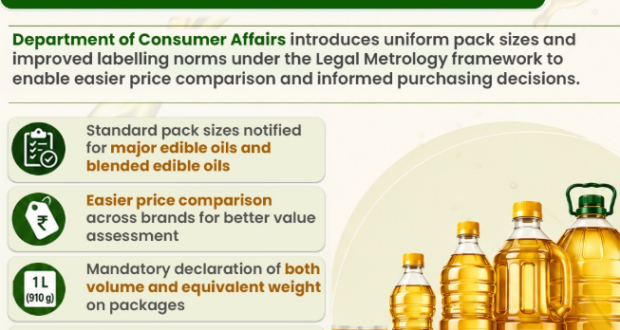
Major Consumer-Centric Reforms Announced for Edible Oil Packaging and Labelling
- Standard pack sizes prescribed for major edible oils and blended edible oils.
- Consumers will be able to compare prices across brands more easily and assess value for money accurately.
- Declaration of both volume and equivalent weight to improve transparency.
- Provisions applicable to both domestically manufactured and imported edible oils.
- A three-month transition period provided for manufacturers, packers and importers.
Standard Pack Sizes Prescribed
The revised SoP prescribes standard pack sizes for major edible oils and blended edible oils, including palm oil, soybean oil, sunflower oil, mustard/rapeseed oil, groundnut oil, sesame oil, rice bran oil, cottonseed oil, and corn oil.
The permitted standard pack sizes are:
- 200 ml/g
- 500 ml/g
- 1 litre/kg
- 2 litre/kg
- 3 litre/kg
- 4 litre/kg
- 5 litre/kg
- 15 litre/kg
- 20 litre/kg
These standard sizes will help consumers compare prices across different brands more easily and make informed purchasing decisions.
Safeguarding Consumer Choice
Packages below 200 ml or 200 grams will continue to remain outside the scope of standardisation, ensuring continued availability of affordable small packs for consumers. Minor edible oils have also been exempted from the standard pack size requirement.
Additional Measures and Implementation
If the quantity of edible oil is shown in litres or millilitres (volume), the package must also clearly mention the equivalent weight. This requirement will be followed as per the Legal Metrology (Packaged Commodities) Rules, 2011. This will help consumers compare products of different brands more easily and make better buying decisions.
The new provisions will apply to both edible oils produced in India and imported edible oils. The existing rules related to sampling, testing, checking net quantity and permissible errors will continue to be governed by the Standard Operating Procedure and the Legal Metrology (Packaged Commodities) Rules, 2011. Manufacturers, packers and importers will get a transition period of three months to implement the new requirements. However, businesses that wish to adopt the standard pack sizes earlier can do so immediately.
The introduction of standard pack sizes will make it easier for consumers to compare prices across brands and understand the value they are getting for their money. It will also help consumers make more informed and transparent purchasing decisions. The initiative will also benefit the edible oil industry by bringing greater uniformity in packaging practices. Standard pack sizes will make compliance easier, encourage fair competition among manufacturers and importers, and help create a more transparent market.
The Department of Consumer Affairs remains committed to protecting consumer interests through reforms that promote transparency, fairness and consumer confidence in the marketplace.