 Odisha news today, Latest Oriya News Bhubaneswar Online Odia news Portal
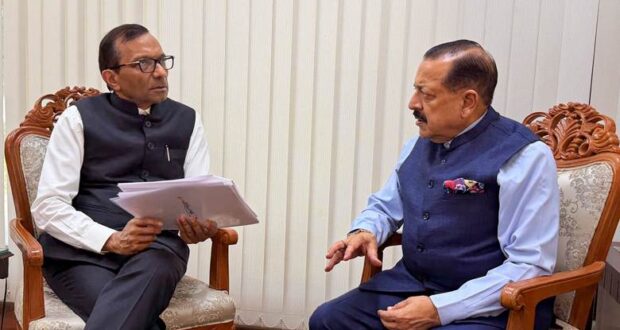
NEW DELHI, April 26: Union Minister of State (Independent Charge) Dr. Jitendra Singh today reviewed plans to set up Space laboratories in universities and colleges across India, with seven such labs to be established in the first phase to provide hands-on exposure to students in satellite systems, rocketry, and mission design.
The initiative is aimed at building a strong pipeline of skilled youth for India’s expanding space sector, which has attracted over USD 600 million in private investment over the past five years following the opening up of the sector to non-government entities.
The review followed a detailed briefing by Chairman, IN-SPACe, Dr Pawan Goenka, who presented an overview of the progress made in India’s Space reforms and the growing participation of private players across the value chain.
India’s private space ecosystem has expanded rapidly, with the number of StartUps increasing from single digit in 2019 to over 400 by early 2026. These start-ups are now active across launch vehicles, satellite and payload manufacturing, ground infrastructure, data services, and emerging in-orbit segments. Increasing global interest is also reflected in rising engagements with international clients, including established space-faring nations.
To support this momentum, a range of focused initiatives have been rolled out. A ₹1,000 crore venture capital fund is being operationalised with SIDBI to support growth-stage startups, while a ₹500 crore Technology Adoption Fund is enabling the transition of early-stage innovations into commercially viable products. The seed fund scheme is providing grants of up to ₹1 crore to startups at the ideation and prototype stage, along with mentoring and ecosystem support.
Efforts to build a skilled workforce are also underway, with 17 specialised training programmes completed and nearly 900 participants certified in areas such as satellite manufacturing, launch vehicle systems, and space cybersecurity. The upcoming space laboratories in universities are expected to further strengthen this talent pipeline by offering practical, hands-on learning opportunities.
On the infrastructure front, new opportunities are being created through initiatives such as a privately-led Earth Observation satellite constellation under a public-private partnership model, development of a shared satellite bus platform for startups, and expanded access to design, integration, and testing facilities at the IN-SPACe Technical Centre in Ahmedabad. Technology transfer programmes, including the Small Satellite Launch Vehicle (SSLV), are also progressing with industry participation.
India’s global engagement in the space sector continues to deepen, with partnerships now spanning over 45 countries. Recent collaborations include agreements with Singapore and the UAE, participation of Indian companies in international space forums, and initiatives to connect domestic startups with global markets.
Since its inception, IN-SPACe has received over 1,000 applications from startups, MSMEs, academic institutions, and industry, and has granted 129 authorisations, reflecting growing confidence in India’s reformed space ecosystem.