 Odisha news today, Latest Oriya News Bhubaneswar Online Odia news Portal
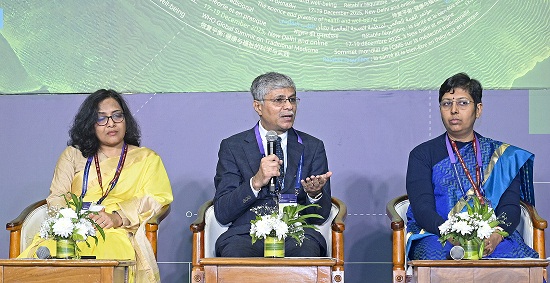
Newdelhi:17/12/25:Ashwagandha (Withania somnifera), one of Ayurveda’s most revered Rasayana herbs, took centre stage at a high-level international side event held on the sidelines of the 2nd WHO Global Traditional Medicine Summit, 2025, reaffirming India’s leadership in advancing traditional medicine through evidence-based global dialogue.
The session, titled “Ashwagandha: From Traditional Wisdom to Global Impact – Perspectives from Leading Global Experts,” was organised by the WHO Global Traditional Medicine Centre (WHO-GTMC) in collaboration with the Ministry of Ayush, Government of India, at Bharat Mandapam, New Delhi. It brought together eminent global experts, regulators, researchers, and policymakers to deliberate on the evolving scientific, regulatory,y and safety landscape surrounding Ashwagandha.
With Ashwagandha gaining growing international recognition for its adaptogenic, neuroprotective, and immunomodulatory properties, the discussions focused on strengthening the bridge between traditional knowledge systems and contemporary scientific validation. Experts underscored the importance of rigorous preclinical and clinical research, safety assessment, pharmacovigilance,e and standardisation to support its responsible global use.
Moderated by Dr. J.B. Gupta, Secretary, World Ashwagandha Council, the session featured keynote presentations by leading international authorities. Dr. Roy Upton of the American Herbal Pharmacopoeia highlighted global benchmarks for identity, quality testing, ng, and therapeutic applications. Ms. Mari Lyyra, Head of Food and Feed at Medfiles Ltd, Finland, shared perspectives on Europe’s regulatory environment and the growing acceptance of Ashwagandha. Dr. Ikhlas Khan, Director of the National Center for Natural Products Research, University of Mississippi, emphasised the need for methodological rigor and robust evidence to inform regulatory decision-making. Dr. Geetha Krishnan of WHO-GTMC addressed the balance between promise and precaution in the global adoption of Ashwagandha.
An interactive panel discussion enabled candid exchanges among experts on harmonising standards, ensuring reproducible efficacy, and fostering collaborative research to advance evidence-based Ashwagandha formulations. The session concluded with a shared consensus on the need for sustained international cooperation to position Ashwagandha within conventional healthcare frameworks while preserving the integrity of traditional wisdom.
The deliberations reflected a growing global commitment to integrating traditional medicine into contemporary health systems in a safe, scientific, and sustainable manner, in line with the broader objectives of the WHO Global Traditional Medicine Summit.
The WHO Global Traditional Medicine Summit provides a global platform for dialogue, cooperation,n and policy alignment on traditional complementarya,ry and integrative medicine, with a strong emphasis on evidence, safety, and quality.