 Odisha news today, Latest Oriya News Bhubaneswar Online Odia news Portal
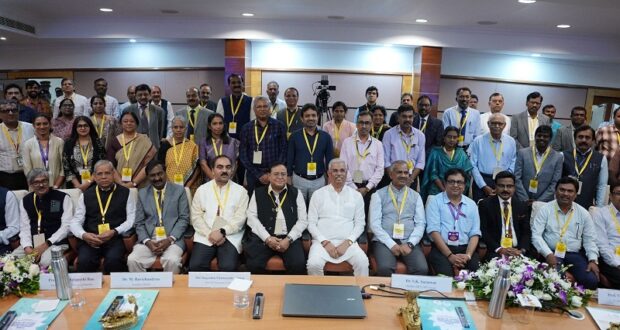
Thiruvanthapuram:2/11/25:The 8th Regional Consultative Meeting on “Ease of Doing Research and Development” was organized by NITI Aayog at the National Centre for Earth Science Studies (NCESS), Thiruvananthapuram, on 30 – 31 October 2025. The consultation brought together a distinguished gathering of Institutional leaders, Vice Chancellors, and Scientific ministry/ departments for in-depth discussions on strengthening India’s research and development ecosystem.
The session commenced with a Welcome Address by Prof. N.V. Chalapathi Rao, Director, NCESS, who underscored the significance of an enabling environment for scientific inquiry and highlighted the role of regional research institutions in driving innovation-led development. Prof. Vivek Kumar Singh, NITI Aayog, set the context for the meeting and introduced the ROPE Framework – Removing Obstacles, Promoting Enablers, as the guiding approach of NITI Aayog’s initiative on Ease of Doing R&D. He emphasized that the framework aims to identify institutional and policy-level challenges faced by researchers and simultaneously promote supportive mechanisms such as flexibility, inter-agency collaboration, and capacity enhancement to create a conducive environment for scientific progress.
Dr. M. Ravichandran, Secretary, Ministry of Earth Sciences, provided targeted suggestions to enhance research efficiency and impact. He recommended leveraging the expertise of the retired scientific talent pool, strengthening the University-Industry-Government (UIG) ecosystem, fostering greater data sharing across institutions instead of working in silos, and improving science communication to make research outcomes more relatable to society.
Dr. V.K. Saraswat, Member, NITI Aayog, in his address, highlighted that the Ease of Doing R&D depends on two critical elements, internal and external factors. While internal factors relate to the structure, governance, and functioning of research institutions, external factors encompass regulatory barriers, funding mechanisms, and cross-sector coordination. He stressed that addressing both dimensions in tandem is essential to realizing India’s vision of becoming a global leader in research and innovation.
The meeting was graced by Shri Rajendra Vishwanath Arlekar, Governor of Kerala, who, in his address, observed that the “Ease of Doing R&D” is intrinsically linked to the broader goal of improving the Ease of Living for citizens. He emphasized that science and technology must be aligned with people-centric development, and that a collaborative approach among institutions, industries, and governments is key to inclusive growth. The Governor remarked that “State development will lead to national development,” reinforcing the need for regionally rooted innovation ecosystems.
The two-day meeting concluded with interactive sessions and consultations with representatives from academic institutes, research laboratories, and government, reaffirming the collective commitment to build an enabling, efficient, and collaborative R&D ecosystem in India.