 Odisha news today, Latest Oriya News Bhubaneswar Online Odia news Portal
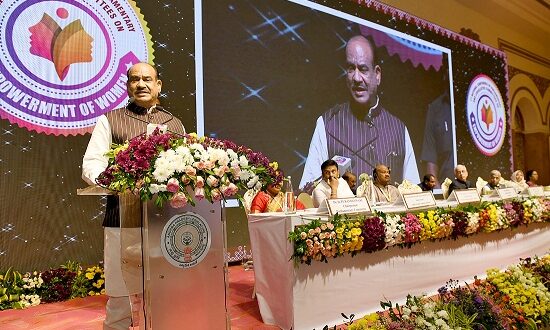
Tirupati:15/9/25 Lok Sabha Speaker Shri Om Birla today highlighted the need for sustainable economic empowerment models for women as the first national conference of Parliamentary and Legislative committees on women’s empowerment concluded in Tirupati, Andhra Pradesh, with the adoption of the ‘Tirupati Resolution’.
Delivering his remarks at the valedictory session of the historic parliamentary conference dedicated to women’s empowerment, the Lok Sabha Speaker stressed that women’s empowerment is not only a social imperative but also an economic necessity. By investing in women’s health, education, skills, and entrepreneurship, India can unlock a vast reservoir of human capital and build a resilient socio-economic model of development, he said.
Shri Birla underlined that the leadership and contribution of women are pivotal to India’s journey towards Viksit Bharat by 2047. He said such conferences provide a platform where legislators, through their experiences at the centre and states, can meet and share their thoughts. Governor of Andhra Pradesh Sh. S. Abdul Nazeer delivered the valedictory remarks.
On the occasion of the International Day of Democracy, the Lok Sabha Speaker underlined that democracy in India is not merely a political arrangement but a civilizational value and a way of life. He stated that India, known as the Mother of Democracy, has for centuries upheld the principles of equality, dialogue, and participation, and that democracy is deeply woven into the cultural and social fabric of the country.
Shri Birla emphasized that women’s empowerment must not be viewed only as a matter of welfare, but as the foundation of national development. He recalled the pioneering role of reformers such as Savitribai Phule, who championed the cause of women’s emancipation through education, and cited the example of schools in Maharashtra that educated elderly women in villages in pursuit of 100 percent literacy. Such initiatives, he noted, remain a source of inspiration for contemporary policies.
Highlighting the achievements of women from rural and underprivileged backgrounds, the Speaker said that their excellence in education, entrepreneurship, and community leadership shows that opportunities, when provided, yield transformational outcomes. He called for a renewed effort to extend these opportunities to every segment of society, so that women can participate fully as equal stakeholders in India’s progress.
The Speaker highlighted how Gender Responsive Budgeting is not merely a financial mechanism but a socio-economic model that integrates women’s needs into the national development agenda. It was stressed that budgets must serve as instruments of social justice, ensuring equal access to healthcare, education, skills, and livelihoods for women, thereby enabling them to fully participate in and lead the nation’s growth journey. Applying a gender lens to resource allocation, he said, ensures that women’s concerns are not treated as peripheral but are integrated into mainstream planning.
He called for institutionalizing Gender Budget Cells in Ministries and State Departments, enhancing allocations for women’s healthcare, education, skills, entrepreneurship, and access to credit, and monitoring outcomes through gender-disaggregated data. Such steps, he noted, would make budgeting a tool of social justice and inclusive growth.
Turning to the opportunities and challenges of emerging technologies, Shri Birla said that women must not be left behind in the digital era. Bridging the digital divide, ensuring cyber safety, and expanding digital literacy programmes are essential to empower women as active creators of technology. He proposed dedicated digital literacy missions for women on the lines of earlier adult literacy campaigns, to ensure inclusive participation in the knowledge economy.
The Conference unanimously adopted the ‘Tirupati Resolution’, which laid down a clear roadmap for advancing women’s empowerment. The Resolution emphasised applying a gender lens across all Ministries and Departments, enhancing allocations for health, education, skills, and entrepreneurship, institutionalizing gender responsive budgeting, and strengthening technical capacity at national and state levels. It is also committed to bridging the digital divide, promoting women’s participation in STEM fields, ensuring cyber safety, expanding digital literacy programmes, and making women active creators of technology. Reaffirming the centrality of women-led development, the Resolution pledged to advance women’s education, health, safety, dignity, and self-reliance as the cornerstone of national progress and the realisation of Viksit Bharat by 2047.