 Odisha news today, Latest Oriya News Bhubaneswar Online Odia news Portal
Bhubaneswar, India, 23rd July, 2025:Governments worldwide are intensifying efforts to combat urban air pollution—a growing crisis linked to serious health risks. In India, the National Clean Air Program (NCAP) plays a key role as the country grapples with rapid urbanization and environmental sustainability. Amidst these efforts, a new study by researchers from IIT Bhubaneswar, published in Nature Portfolio Journal Communications Earth & Environment, offers surprising insights into urban pollution patterns in India’s northern regions. The study has been conducted by Dr. V. Vinoj, Associate Professor, School of Earth, Ocean and Climate Sciences, and research scholar Soumya Satyakanta Sethi.
The Findings:
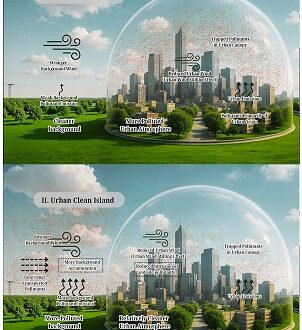
Traditionally, cities have been regarded as pollution hotspots, with elevated pollution over cities than the surrounding non-urban regions — a pattern commonly known as the ‘urban pollution dome’ or ‘urban pollution island’ effect. Surprisingly, the recent study found that this pattern does not hold true in many northern Indian cities. Instead of a concentrated urban pollution dome, these cities display a ‘clean island’ effect — or what the researchers describe as a ‘punctured pollution dome’, where the city centers are, unexpectedly, relatively cleaner than the heavily polluted surrounding areas.
What could be driving such patterns?
Researchers attribute this unexpected pattern to an “invisible barrier” formed by a city’s rough surface—tall buildings and uneven structures—that slows down wind and leads to stagnant air. This limits pollutant dispersion, causing pollution to accumulate within the city and forming a typical urban pollution dome. However, this same barrier can also prevent polluted air from outside the city from entering. As a result, in some cases, pollution builds up in the areas surrounding the city, making the city center appear relatively cleaner.
Based on two decades of high-resolution aerosol data across 141 Indian cities, the study found that southern cities—less affected by pollution transported from afar—exhibit classic domes with more pollution inside. In contrast, cities in northern and northwestern India, particularly the Indo-Gangetic Plain, experience heavy regional and long-range pollution, such as dust. There, the city’s barrier blocks these pollutants, causing them to accumulate in surrounding non-urban areas and forming what the researchers describe as “clean air domes.”
Major Implications:
These findings challenge long-standing assumptions about urban air pollution, particularly the notion that transported aerosols simply add up over the cities and uniformly degrade air quality. Additionally, the study highlights that monitoring air pollution solely at city boundaries may provide an incomplete picture, as the actual dynamics involve a complex interplay between local emissions, regional transport, microclimatic effects, and atmospheric processes.
Uncovering these hidden atmospheric dynamics is only the beginning. Achieving truly sustainable and climate-resilient cities requires a deeper, integrated understanding of how urban environments interact with atmospheric processes. Thus, the recent advancements in city-scale urban digital twins—such as those being developed by IIT Bhubaneswar—offer a promising platform to seamlessly incorporate these dynamics not just for air quality, but other critical urban challenges, including heat stress, shifting rainfall patterns, flooding, and long-term climate impacts.
Link to the study:https://www.nature.com/articles/s43247-025-02538-0