 Odisha news today, Latest Oriya News Bhubaneswar Online Odia news Portal
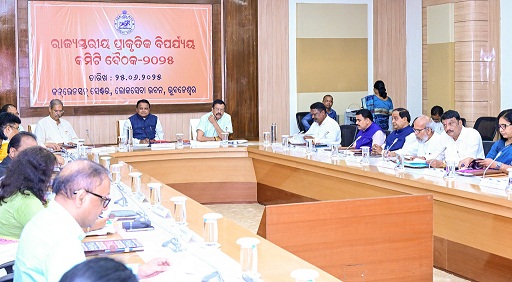
Bhubaneswar:25/6/25: Reiterating the state government’s unwavering commitment to disaster resilience, Odisha Chief Minister Mohan Charan Majhi on Tuesday said there would be no compromise in ensuring zero casualties during natural disasters, whether it pertains to human lives or livestock.
Chairing the State-Level Natural Disaster Committee Meeting 2025 at Lok Seva Bhawan Convention Centre, the Chief Minister said, “Odisha is a disaster-prone state, but our preparedness and timely interventions have saved countless lives in the past. Our goal remains unchanged – zero casualties, and we stand with the people of Odisha in all situations.”
He stated that from June to October, Odisha experiences heavy rains and floods due to the southwest monsoon, resulting in recurring damage to life and property. He emphasised that while natural calamities cannot be prevented, loss and damage can be significantly minimised through robust preparedness, inter-departmental coordination, and modern disaster management strategies.
“The Bay of Bengal is the most cyclone-prone region in the world, and Odisha remains in the direct path of most landfalls,” said Majhi. He highlighted the state’s recent success in managing Cyclone Dana, which affected 14 districts, but was handled efficiently with zero casualties.
The CM also spoke about the 2024 floods in Malkangiri, Balasore, and Mayurbhanj, and how immediate relief, rehabilitation, and restoration efforts were carried out. The government also compensated farmers for crop loss due to unseasonal rains, declared as a state-specific disaster.
“In the last summer season, only one heatwave-related death was reported from Balangir. Prompt compensation was given. This reflects our effective heatwave management,” the CM added.

The CM announced a major irrigation target: 15 lakh hectares of agricultural land to be brought under irrigation in the next five years to tackle future drought-like conditions. Stressing public health during disasters, he directed that all tube wells be disinfected; adequate stocks of medicines and anti-snake venom be kept in health centres; and relief and rescue teams, including ODRAF, NDRF, and Fire Services, remain in a state of readiness.
“We will not make any compromise on our Zero Casualty policy — not even in case of livestock,” Majhi asserted, calling for warning systems, quick mobilisation of resources, and effective communication during emergencies.
Revenue and Disaster Management Minister Suresh Pujari emphasised the need for trained manpower and modern equipment. He announced that Doppler radars would be installed at Sambalpur, Balasore, and Bhubaneswar for better weather tracking.
The state has already constructed 909 multi-purpose cyclone/flood shelters in 25 vulnerable districts, and undertaken mass palm plantation drives to reduce lightning deaths.
Emergency control rooms have been activated at the district level, providing 24×7 disaster alerts and assistance. The meeting was attended by Deputy Chief Minister Kanak Vardhan Singh Deo, Ministers Nityananda Gond, Mukesh Mahaling, Prithviraj Harichandan, Rabi Narayan Nayak, Krushna Chandra Mahapatra, and others.
MPs and MLAs, including Pratap Sarangi, Satyagiri Ulaka, Ramakant Bhoi, Akash Das Nayak, Anita Subhadarshini, Saroj Pradhan, and several others shared their suggestions and concerns.