 Odisha news today, Latest Oriya News Bhubaneswar Online Odia news Portal
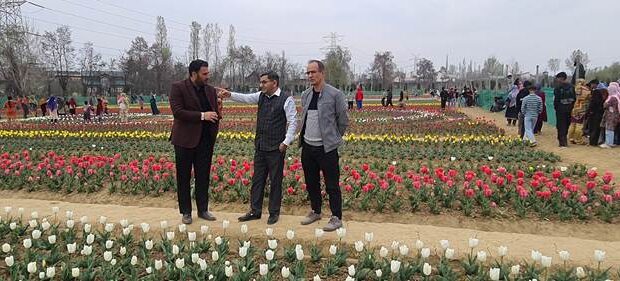
Newdelhi:4/4/25:The scenic beauty of Kashmir’s tulip gardens has long been a major attraction for tourists, with vibrant displays at Srinagar drawing visitors each year. In a significant step toward promoting sustainable floriculture and enhancing farmers’ income, CSIR Indian Institute of Integrative Medicine (CSIR-IIIM), Jammu a premier research and development institution of the Council of Scientific and Industrial Research (CSIR) under the Union Ministry of Science and Technology, mandated with pre-clinical drug discovery, has also been implementing various societal Mission programmes like CSIR’s Aroma and Floriculture Mission. Under the CSIR Floriculture Mission, the key verticals include Generation of Quality Planting Material for High Value Floricultural Crops, Area Expansion under Floriculture, Urban Floriculture, Post-Harvest Processing Value Addition, Integration of Floriculture Apiculture, Establishing Marketing Linkages, and Domestication of Wild Ornamentals. Further, through the Mission activities, the institute has been dedicated to supporting farmers through research and development, particularly in high-value floricultural crop cultivation.
In conformity with the vision of Viksit Bharat 2047, the Prime Minister’s clarion call for self-reliant India, the pan India CSIR Societal Mission programmes envisioned by Dr. Jitendra Singh, Union Minister of State for Science and Technology (Independent Charge) achieved remarkable achievements since the last few years. The Institute initiated tulip cultivation at its Bonera Station in the year 2022 with the primary objectives of indigenizing tulip bulb production, developing agro-technological protocols, and expanding crop cultivation. A spokesperson informed that the initiative which started with just 10,000 bulbs in 2022, has successfully produced over one lakh bulbs within just two years, grown over an area of more than 12 kanals this season.
During media interaction held at Tulip Garden of Bonera Field Station, Dr. Zabeer Ahmed, Director of CSIR-IIIM, Jammu, highlighted the significance of this initiative, stating that the Bonera Station currently houses eight tulip varieties under strategic research programmes to develop Indigenous tulip bulbs, assess morphological characteristics, establish agro-technological protocols and evaluate varieties for resistance to biotic and abiotic stresses. He emphasized that indigenizing tulip bulb production will reduce India’s reliance on imports, create economic opportunities for farmers, and contribute to the overall growth of the floriculture sector.
The newly developed Tulip Garden-cum-Experimental Field at Bonera, located in South Kashmir’s Pulwama, was opened to the public and drew thousands of enthusiastic visitors from all parts of the valley. The initiative marks a significant step toward positioning Jammu and Kashmir as a hub for tulip bulb production in the future, aiming to shift India from an import-dependent consumer to a self-sufficient producer. By integrating scientific advancements with floriculture tourism, the CSIR Floriculture Mission, besides fostering self-reliance in tulip production, also aims to enhance the economic potential of the region’s farming communities.