 Odisha news today, Latest Oriya News Bhubaneswar Online Odia news Portal
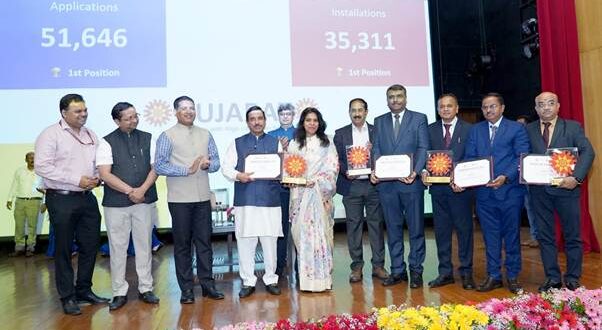
Newdelhi:4/6/26:PM Surya Ghar: Muft Bijli Yojana has already crossed 40 lakh beneficiary households within 2 years and I am hopeful that by the end of 2026, we will cross 75 lakh households by December 2026, said Union Minister for New and Renewable Energy and Consumer Affairs, Food and Public Distribution, Shri Pralhad Joshi while participating in a fireside chat programme organised during ‘Two years of PM Suryaghar Muft Bijli Yojana: Scaling the solar home to 1 crore rooftops’ event here today.
Shri Joshi said the Utility-Linked Aggregation (ULA) model is designed to accelerate implementation, particularly among underserved households. Under the model, around 30 lakh rooftop solar installations have already been planned across States, with utilities playing a key role in facilitating faster adoption and execution. He noted that the initiative will particularly benefit families consuming between 1 kW and 3 kW of electricity and help ensure wider access to affordable clean energy. With more than 65 lakh applications already in the pipeline, the scheme is witnessing strong public participation and unprecedented momentum across the country.
The Union Minister said India’s solar growth is accelerating rapidly. He highlighted that the first 50 GW took 96 months. The next 50 GW took 36 months and growth from 100 GW to 150 GW took only 14 months. Adding on, he said that May 2026 was the strongest month since launch of PM Suryaghar Muft Bijli Yojana with a record 3.16 lakh rooftop solar installations in a single month and 15,000 households added in just one day.
The Minister reiterated that the pace of adoption has increased automatically from 118 days to add one lakh households to less than eight days today. He said more than ₹22,750 crore in subsidies has been dispersed, including ₹2,743 crore in May 2026 alone. “PM Suryaghar Muft Bijli Yojana is creating one of the world’s largest residential solar markets while advancing India’s clean energy transition and energy self-reliance,” he said.
Shri Joshi said that at a time when the world is facing energy uncertainties due to the West Asia Crisis, initiatives like PM Suryaghar Muft Bijli Yojana are strengthening India’s energy security and strategic resilience. He said rooftop solar installations have increased from about 7000 per month before the scheme to over three lakh per month today. More than 17 lakh households have achieved zero electricity bills, demonstrating direct savings from families.
The programme also featured two high-level plenary sessions, focusing on the future trajectory of rooftop solar in India. The first plenary session, “From 40 Lakh to 1 Crore: The PM Surya Ghar Journey”, brought together senior representatives from the Ministries of New and Renewable Energy, Power and Finance, along with leading financial institutions, to deliberate on policy, financing and implementation priorities for scaling adoption to one crore households. The second plenary session, “Subnational Frontiers: Powering the State-Led Solar Surge”, convened senior state energy leaders to discuss cross-state learnings, innovative incentive models, and strategies to balance rooftop solar expansion with DISCOM sustainability and state-level energy priorities.