 Odisha news today, Latest Oriya News Bhubaneswar Online Odia news Portal
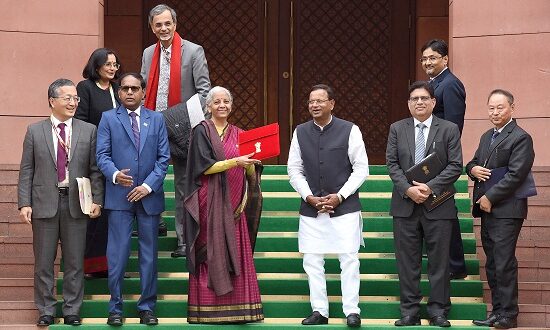
Newdelhi:1/2/26:The Union Budget 2026-27 emphasizes Scaling up manufacturing in 7 strategic and frontier sectors. While presenting the Union Budget 2026-27 in Parliament today, Union Minister of Finance & Corporate Affairs Smt Nirmala Sitharaman said that the proposed interventions forms part of six areas under ‘First Kartavya’ in the Budget.
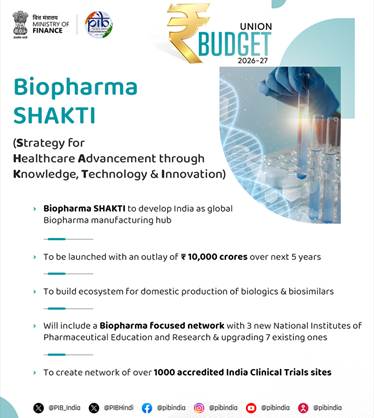
To develop India as a global Biopharma manufacturing hub, the Budget proposes Biopharma SHAKTI with an outlay of ₹ 10,000 crores over the next 5 years. This will build the ecosystem for domestic production of biologics and biosimilars. The Strategy as envisaged in the Budget will include a Biopharma-focused network with 3 new National Institutes of Pharmaceutical Education and Research (NIPER) and upgrading 7 existing ones. It will also create a network of over 1000 accredited Indian Clinical Trials sites. The Union Budget proposes to strengthen the Central Drugs Standard Control Organisation to meet global standards and approval timeframes through a dedicated scientific review cadre and specialists.
For expanding India’s semiconductor sector capabilities and building on India Semiconductor Mission (ISM) 1.0, the Union Budget proposes to launch ISM 2.0 to produce equipment and materials, designfull-stackk Indian IP, and fortify supply chains. Smt Sitharaman said that the focus will be on industry-led research and training centres to develop technology and a skilled workforce.
The Electronics Components Manufacturing Scheme, launched in April 2025, has an outlay of ₹22,919 crore. The Union Budget 2026-27 proposes to increase the outlay to ₹40,000 crore to capitalise on the momentum.
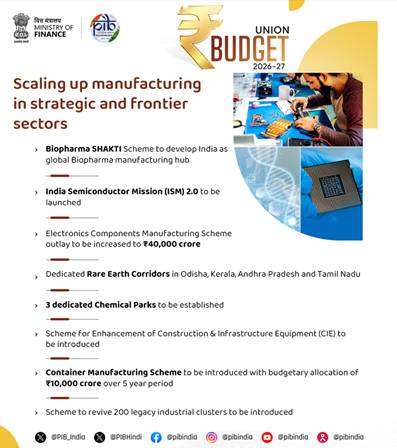
On a Scheme for Rare Earth Permanent Magnets, the Union Budget proposes to support the mineral-rich States of Odisha, Kerala, Andhra Pradesh, and Tamil Nadu for establishing dedicated Rare Earth Corridors to promote mining, processing, research,h and manufacturing.
To enhance domestic chemical production and reducimport dependencycy, the Union Minister proposed to launch a Scheme to support States in establishing 3 dedicated Chemical Parks, through a challenge route, on a cluster-based plug-and-play model.
In her Budget speech, Smt. Nirmala Sitharaman stated that Strong capital goods capability is a determinant of productivity and quality across different sectors. Towards building this capacity, the Union Budget proposes Hi-Tech Tool Rooms to be established by CPSEs at 2 locations as digitally enabled automated service bureaus that locally design, test, and manufacture high-precision components at scale and at lower cost. A Scheme for Enhancement of Construction and Infrastructure Equipment (CIE) will be introduced to strengthen domestic manufacturing of high-value and technologically-advanced CIE. This can range from lifts in a multi-story apartment, fire-fighting equipment, large and small, to tunnel-boring equipment for building metros and high-altitude roads. The Budget also proposes a Scheme for Container Manufacturing to create a globally competitive container manufacturing ecosystem, with a budgetary allocation of ₹10,000 crore over 5 years.
For the labour-intensive Textile Sector, it proposes that an Integrated Programme with 5 sub-parts; firstly, the National Fibre Scheme for self-reliance in natural fibres such as silk, wool and jute, man-made fibres, and new-age fibres; secondly, Textile Expansion and Employment Scheme to modernise traditional clusters with capital support for machinery, technology upgradation and common testing and certification centres; thirdly, a National Handloom and Handicraft programme to integrate and strengthen existing schemes and ensure targeted support for weavers and artisans; fourthly, Tex-Eco Initiative to promote globally competitive and sustainable textiles and apparels; fifthly, Samarth 2.0 to modernize and upgrade the textile skilling ecosystem through collaboration with industry and academic institutions.
With a focus on bringing value addition to technical textiles, the Union Budget proposes to set up Mega Textile Parks in a challenge mode.
Further, the Union Budget proposes to launch the Mahatma Gandhi Gram Swaraj initiative to strengthen khadi, handloom,m and handicrafts. This will help in global market linkage and branding. The budget specifies that it will streamline and support training, skilling, quality ofprocesse, ss and production. This will benefit our weavers, village industries, One – District – One – Product initiat,ive and rural youth, the Budget added.
During the presentation of the budget, Smt Sitharaman said that India has the potential to emerge as a global hub high-qualitylity, affordable sports goods. In this endeavour, the Budget proposes a dedicated initiative for sports goods that will promote manufacturing, research, and innovation in equipment design as well as material sciences.