 Odisha news today, Latest Oriya News Bhubaneswar Online Odia news Portal
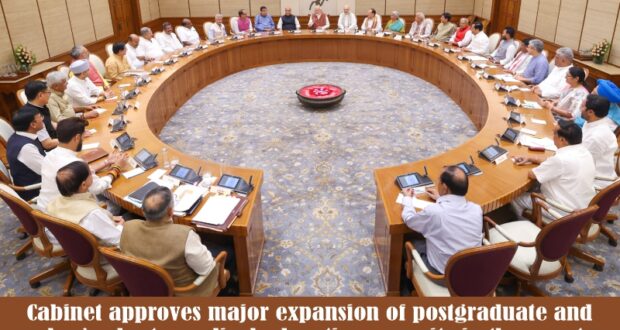
Newdelhi:24/9/25:The Union Cabinet chaired by the Prime Minister, Shri Narendra Modi, has approved the Phase-Ill of the Centrally Sponsored Scheme (CSS) for strengthening and upgradation of existing State Government/ Central Government Medical Colleges/ Standalone PG Institutes/ Government Hospitals for increasing 5,000 PG seats and extension of the CSS for upgradation of existing government medical colleges for increasing 5,023 MBBS seats with an enhanced cost ceiling of Rs. 1.50 crore per seat. This initiative will significantly augment the undergraduate medical capacity; increase the availability of specialist doctors by creating additional postgraduate seats; and enable the introduction of new specialties across Government medical institutions. This will strengthen the overall availability of doctors in the country.
The total financial implications of these two schemes are Rs 15,034.50 crore for a period from 2025-26 to 2028-29. Out of Rs 15034.50 crore, the central share is Rs 10,303.20 crore and the state share is Rs 4731.30 crore.
Benefits:
Schemes for augmenting medical seats in government medical colleges/institutions across States/UTs will help augment the availability of doctors and specialists in the country, thereby improving access to quality healthcare, especially in underserved areas. It will also leverage existing infrastructure for cost-effective expansion of tertiary healthcare in the Government institutions, as expansion of postgraduate seats ensures a steady supply of specialists in critical disciplines. These schemes aim to promote balanced regional distribution of healthcare resources while being cost-effective by leveraging existing infrastructure. In the long run, they strengthen the country’s health systems to meet existing and emerging health needs.
Impact, including employment generation:
The major outputs/outcomes expected from the schemes are:
i. Providing more opportunities to the students to pursue medical education in India.
ii. Enhancing the quality of medical education and training to meet global standards.
iii. Adequate availability of doctors and specialists can position India as a prime destination for providing affordable healthcare and thus boosting foreign exchange.
iv. Bridging the gap in healthcare accessibility, particularly in underserved rural and remote areas.
v. Generating direct and indirect employment opportunities in terms of doctors, faculty, paramedical staff, researchers, administrators, and support services.
vi. Strengthening the health system’s resilience and contributing to overall socio-economic development.
vii. Promoting equitable distribution of healthcare infrastructure across States/UTs.
Implementation Strategy and targets:
The target of these schemes is to increase 5000 PG seats and 5023 UG seats in government institutions by 2028-2029. Detailed guidelines will be issued by the Ministry of Health & Family Welfare (MoH&FW) for the implementation of the schemes.
Background:
Realizing Universal Health Coverage (UHC) for 1.4 billion people critically depends on building a robust healthcare system capable of delivering timely, high-standard services at all levels—particularly in rural, tribal, and hard-to-reach communities. A robust healthcare system hinges on the availability of a skilled and adequate workforce.
India’s healthcare education and workforce infrastructure have witnessed significant growth in recent years, reflecting a sustained policy focus on expanding access and improving quality. As of date, India has 808 medical colleges, the highest in the world, with a total intake capacity of 1,23,700 MBBS seats. In the last decade, we added over 69,352 new MBBS seats, registering a growth of 127%. Similarly, during this period, 43,041 PG seats were added, showing an impressive growth of 143%. In spite of this notable growth in the number of medical seats, in certain regions, there is a need to enhance capacities to match the demand, access, and affordability of healthcare.
Further, the twenty-two new All India Institute of Medical Sciences (AIIMS) approved under the Pradhan Mantri Swasthya Suraksha Yojana (PMSSY), apart from providing tertiary healthcare service, are also playing an important role in building a pool of health professionals with the highest standards of medical competence with their state-of-the-art teaching and learning facilities.
To expand the pool of qualified faculty, the new Medical Institution (Qualifications of Faculty) Regulations 2025 have been issued by adopting a more inclusive and competency-based approach to faculty eligibility and recruitment. These changes aim to address the growing requirement of teaching personnel and the academic and professional standards.
To augment the availability of qualified human resources in health, MoH&FW is administering these schemes, and their further extension underscores the Government’s commitment to creating capacity for the production of more medical professionals, strengthening human resources for health, and improving access to quality healthcare services for the people of India.