 Odisha news today, Latest Oriya News Bhubaneswar Online Odia news Portal
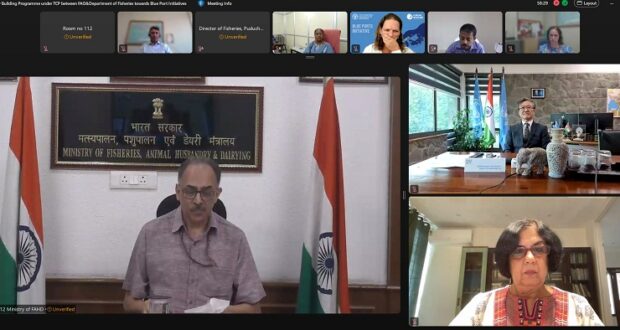
Newdelhi;18/9/25; The Department of Fisheries (DoF), under the Ministry of Fisheries, Animal Husbandry and Dairying (MoFAHD), has signed a Technical Cooperation Programme (TCP) agreement with the Food and Agriculture Organization (FAO) of the United Nations to strengthen Blue Port infrastructure in India. In line with this, the Department of Fisheries organized the first webinar today, under the FAO’s TCP programme, as part of a series of three webinars and physical workshops to build capacity and share global best practices. Dr. Abhilaksh Likhi, Secretary, DoF, addressed the webinar on the topic of “Foundations of a Blue Port: Generating Value in Fishing Ports”. The webinar also witnessed participation from Mr Takayuki Hagiwara, FAO Representative in India.
During his address, Dr. Abhilaksh Likhi, emphasized that fishing ports are not just physical infrastructures but strategic gateways to economic prosperity, ecological sustainability, and social inclusion. He reiterated the government’s vision of developing ecologically healthy, economically viable, and socially inclusive fisheries systems to strengthen national food and nutritional security. Emphasizing the integration of advanced technologies such as 5G, artificial intelligence, automation, and digital platforms, he highlighted their role in enhancing efficiency and service delivery at fishing ports. He underlined the contribution of flagship schemes like PMMSY and FIDF in driving modernization and stakeholder empowerment and called for collaborative efforts between public and private stakeholders to address climate resilience, traceability, and energy transition in port operations. Welcoming FAO’s support in piloting strategic upgrades at Vanakbara ( Diu) and Jakhau (Gujarat) ports, he noted that under PMMSY, three Smart and Integrated Fishing Harbours are being developed in Gujarat, Daman & Diu, and Puducherry with a total investment of ₹369.80 crores.
The webinar featured expert presentations by FAO officials, including Mr. Jose Estors, Ms. Yolanda Molares, and Ms. Lucia Lopez de Aragon, on the concept of Blue Ports and their role in promoting sustainable, inclusive, and innovative practices to enhance efficiency, reduce environmental impact, and generate socio-economic benefits. The sessions covered a roadmap for transitioning ports towards sustainability and stronger stakeholder collaboration, a case study on the Port of Vigo (Spain) showcasing successful implementation and participatory discussions on the key challenges and possible actions for adopting the Blue Ports approach in India. The webinar served as an important platform for sharing global best practices and fostering collaboration among stakeholders. The deliberations are expected to support India’s efforts in developing sustainable, technology-driven, and inclusive Blue Ports, thereby strengthening livelihoods, promoting exports, and enhancing the competitiveness of the fisheries sector.
The event also witnessed participation from senior officials of FAO Headquarters, representatives from the Port of Vigo (Spain), senior government officials from coastal States and Union Territories, Maritime Boards, Major Port Authorities, Fisheries cooperatives, and other key stakeholders.
About FAO’s Technical Cooperation Programme (TCP)
The FAO’s Technical Cooperation Programme (TCP) on ‘Strengthening of Blue Ports’ intends to assist the GoI to strengthen the fishing ports’ technical capacities to address the main environmental, social and economic challenges that affect the aquatic value chain. Two pilot fishing ports, specifically Vanakbara (Diu) and Jakhau in Gujarat, will benefit from this TCP that will provide them with specific strategic and operational tools to identify and formulate investment projects, whose implementation would address the main challenges. Also, a capacity-building programme will be provided, aimed at public and private stakeholders, to better comprehend the main challenges and provide solutions that address the sustainability of fishing ports.
Blue Ports framework
Under the “Blue Ports” framework, the DoF is leading the development of Smart and Integrated Fishing Harbours that combine technological innovation with environmental stewardship. Three pilot harbours, namely Vanakbara (Diu), Karaikal (Puducherry), and Jakhau (Gujarat), have been approved with a total investment of ₹369.8 crores. These modern harbours aim to revolutionize post-harvest fisheries infrastructure by ensuring safer, cleaner, and more efficient operations for India’s fishing communities. Supported under the PMMSY, the initiative integrates smart technologies such as IoT devices, sensor networks, satellite communication, and data analytics to streamline harbour operations and enable real-time decision-making. Eco-friendly features such as rainwater harvesting, energy-efficient lighting, electric-powered equipment, and robust waste management systems—including sewage treatment plants and marine debris clean-up—underscore the commitment to sustainability while enhancing economic performance, social inclusion, and ecosystem protection.