 Odisha news today, Latest Oriya News Bhubaneswar Online Odia news Portal
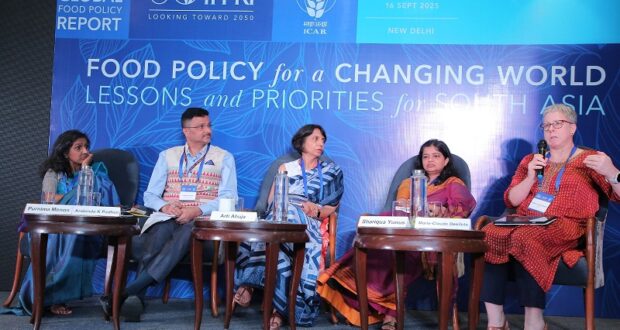
Newdelhi:18,09, 2025: The International Food Policy Research Institute (IFPRI), in partnership with the Indian Council of Agricultural Research (ICAR), convened a high-level regional policy dialogue, “Food Policy for a Changing World: Lessons and Priorities for South Asia”, on September 16, 2025, in New Delhi. The event also marked the South Asia launch of IFPRI’s 2025 Global Food Policy Report (GFPR). The dialogue brought together senior policymakers, researchers, and development partners to reflect on how South Asia can secure resilient, inclusive, and sustainable food systems amid mounting pressures of climate change, malnutrition, and demographic transitions.
The chief guest, Prof. S. Mahendra Dev, Chairman, Economic Advisory Council to the Prime Minister of India (EAC-PM), reminded participants that the food systems agenda cannot lose sight of traditional priorities: Governments and the private sector must work together to reshape food systems that deliver affordable, healthy, and diversified diets.”
Nutrition was another central theme. Dr. Vinod K. Paul, Member, NITI Aayog, emphasized early interventions: “If we truly want to break the intergenerational cycle of malnutrition, we must act before pregnancy.”
State innovations also featured prominently. Smt. Anu Garg, DC– cum –ACS, Government of Odisha, reflected on her state’s progress: “Odisha’s journey from districts once infamous for starvation deaths to becoming the fifth-largest rice producer in India shows what determined institution-building and investment in irrigation can achieve. Today, our focus is on embedding climate resilience into agriculture so that this progress endures.”
Continuing this theme, Dr. Arabinda Kumar Padhee, Principal Secretary, Department of Agriculture and Farmers’ Empowerment, Government of Odisha, highlighted Odisha’s integrated approach: “Odisha is perhaps one of the few states where we have both a climate resilience cell and we are going to have a Gender Responsive Cell. Through CRC and GRC we wanted to build into our design the gender and climate lens from the beginning.” He also noted that regional cooperation initiatives, such as Seeds Without Borders, demonstrate how cross-country collaboration can accelerate the spread of climate-resilient varieties.
The broader environmental dimension was brought into focus by Dr. Angela Lusigi, India Representative, United Nations Development Programme (UNDP), called for inclusive and integrated solutions that combine innovation with traditional knowledge. Dr. Purnima Menon, Senior Director, Food and Nutrition Policy and Acting Director, Transformation Strategies, IFPRI, reinforced IFPRI’s role as a global connector of policy evidence.
Summing up the stakes for the region, Dr. Shahidur Rashid, Director, IFPRI-South Asia, noted: “This year’s Global Food Policy Report is special – it not only marks IFPRI’s 50-year journey, but also reflects on the future policy challenges that will shape food and agriculture in the decades ahead.”
The South Asia Dialogue, co-hosted by IFPRI and ICAR, underscored the region’s shared responsibility and opportunity to lead. Anchored in evidence, enriched by experience, and committed to collaborative solutions, the discussions set the stage for food systems transformation that prioritizes resilience, equity, and nutrition for all.