 Odisha news today, Latest Oriya News Bhubaneswar Online Odia news Portal
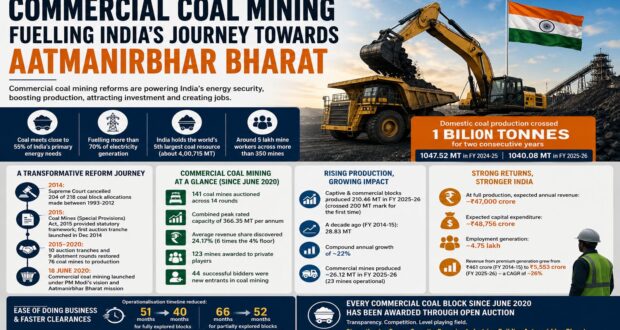
Newdelhi:2/8/26:Commercial coal mining has emerged as a key driver of India’s efforts to strengthen energy security and achieve the vision of Aatmanirbhar Bharat, with domestic coal production crossing one billion tonnes for two consecutive years and private sector participation expanding significantly since the launch of commercial coal auctions in 2020.
Coal continues to play a central role in India’s energy landscape, meeting nearly 55 per cent of the country’s primary energy requirements and contributing more than 70 per cent of electricity generation. India possesses the world’s fifth-largest coal resources, estimated at 4,00,715 million tonnes, and is the second-largest producer and consumer of coal globally. Around five lakh mine workers are engaged in coal production across more than 350 mines.
According to the Coal Ministry, domestic coal production reached 1,047.52 million tonnes in FY 2024-25 and 1,040.08 million tonnes in FY 2025-26, compared with 609.18 million tonnes in FY 2014-15. A substantial share of this growth has been driven by captive and commercial coal blocks, whose contribution to national coal production increased from 10.9 per cent in FY 2021-22 to 20.2 per cent in FY 2025-26.
The current commercial coal mining framework was introduced following the Supreme Court’s 2014 decision cancelling 204 of the 218 coal block allocations made between 1993 and 2012, citing the absence of a transparent and objective allocation process. The Coal Mines (Special Provisions) Act, 2015 subsequently established a statutory framework for the reallocation of coal blocks through transparent auctions. Between 2015 and 2020, ten auction tranches and nine allotment rounds restored 76 coal mines to production.
A major policy shift came on June 18, 2020, when commercial coal mining was launched under the vision of Prime Minister Narendra Modi and the Aatmanirbhar Bharat mission. The reform allowed companies to sell coal freely to any consumer at market-determined prices, removing the earlier restriction that coal could only be used for captive purposes.
The new regime also replaced the fixed per-tonne payment system with a revenue-sharing model under which successful bidders pay the government a percentage of their revenue linked to the National Coal Index. Eligibility norms were broadened by removing the requirement for prior mining experience, permitting participation by joint ventures and consortia, and allowing 100 per cent foreign direct investment through the automatic route.
Since the launch of commercial coal mining, 141 coal mines have been auctioned across 14 rounds, with a combined peak-rated production capacity of 366.35 million tonnes per annum. The average revenue share discovered through these auctions stands at 24.17 per cent, substantially higher than the prescribed floor of 4 per cent. Of the auctioned mines, 123 have been awarded to private companies, including 44 firms entering coal mining for the first time.
Captive and commercial coal blocks together produced around 210.46 million tonnes of coal in FY 2025-26, crossing the 200 million tonne mark for the first time. A decade earlier, production from these blocks stood at 28.83 million tonnes, reflecting a compound annual growth rate of about 22 per cent. Commercial mines alone contributed approximately 26.12 million tonnes during FY 2025-26, with 23 mines currently operational after obtaining Mine Opening Permission.
The Ministry estimates that, once fully operational, the commercially auctioned coal blocks will generate annual revenue of around ₹47,000 crore, attract capital investment of approximately ₹48,756 crore and create employment opportunities for about 4.75 lakh people.
Revenue accruing to the exchequer has also grown significantly. Premium generation increased from ₹461 crore in FY 2014-15 to ₹5,553 crore in FY 2025-26, representing a compound annual growth rate of around 26 per cent and benefiting both the Centre and coal-producing states.
The Ministry is now focusing on expediting the operationalisation of auctioned mines by simplifying regulatory clearances and improving ease of doing business. As part of these efforts, the scheduled operationalisation timeline has been reduced from 51 months to 40 months for fully explored coal blocks and from 66 months to 52 months for partially explored blocks, effective from the ongoing 15th round of commercial coal auctions.
The Ministry said that all commercial coal blocks auctioned since June 2020 have been allocated through transparent and competitive bidding, creating a level playing field for public and private sector participants. It added that these reforms are aimed at strengthening India’s energy security, supporting key sectors such as power and steel, and advancing the country’s journey towards self-reliance.